Harvest Hosts vs Hipcamp – Which Is Better?

There are plenty of options for parking your RV or camper van when you go camping. Sometimes it’s good to stay in campgrounds but other times you just need a break from the norm. Harvest Hosts locations are a great option for accomplishing this and allows you to enjoy something a bit more unique.

Rather than just parking all up next to others in a crowded situation, you can be the only one parked in a location at a beautiful winery, farm, golf course, or other picturesque attraction.

The same can be said for Hipcamp locations. Hipcamp is similar to Airbnb but offers properties for camping. Other people rent out their property for you to stay on. In much the same way as Harvest Hosts, this allows you to get away from the normal crowds of campgrounds and experience more solitude. The right location can give you the peaceful camping experience that we all dream about.

While both of these services have similarities, there are plenty of differences that would make one wonder if one is better than the other.

Although I don’t consider one better than the other, I’ll try to share some experiences I’ve had with both types of locations. These are the two primary locations that I stay at when I travel. They are my go-to places and while there might not be a Harvest Hosts location in an area where I’m going, there will likely be a Hipcamp location available. Likewise, I can often find a Harvest Hosts location in an area where a Hipcamp location may not be available.

Both of these are great options to have available to you and can serve as a perfect way to enjoy a peaceful night in idyllic locations.

Click here to read my full review of Harvest Hosts.

My full review of Hipcamp can be found here.

Below, I’d like to compare them to each other so that you can decide which is best for you.

Similarities

Both Make Use of Other Peoples Properties

Whether it’s a business location of a Harvest Hosts, or a private location via a Hipcamp offering, both of these utilize land owned by others who have opened it up for you to park on and enjoy for a specified amount of time. With Harvest Hosts, this is generally a one-night deal while Hipcamp allows for as many nights as you want to pay for.

They Are Often in Great Locations

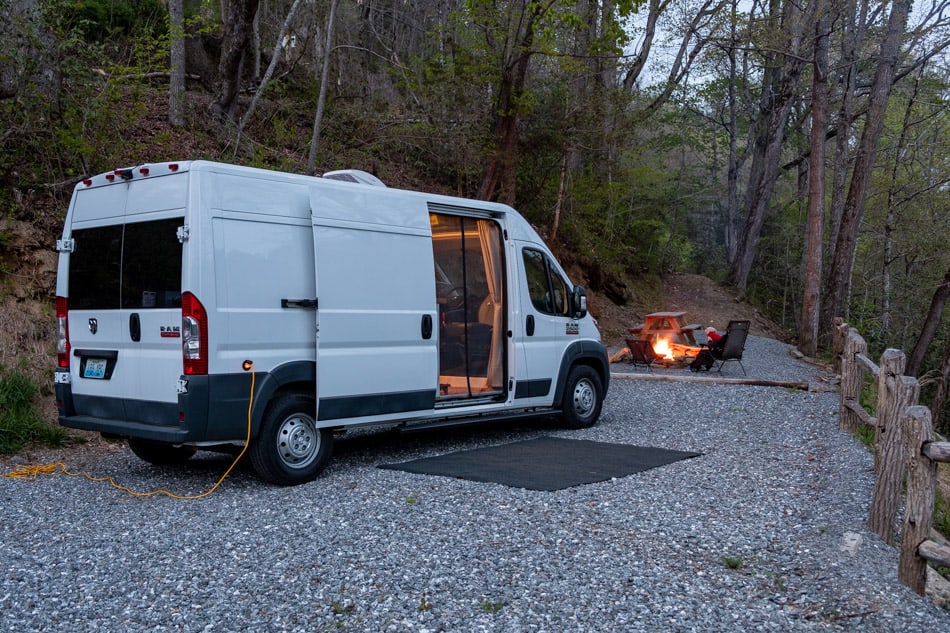
Sitting in camper van with great view

Usually, a stay at either of these types of locations will put you into a scenic place. Many vineyards and farms offered through Harvest Hosts are on lots of land and will give you the private setting that we campers can certainly appreciate.

Many of the places offered by Hipcamp are located in a country setting and you can use their booking system to find a place nearly anywhere you wish.

There are also some places offered through both services that are not ideal. Many of them are decent enough to stay at if you are passing through and may be all you have available in some areas.

There are some places offered that aren’t any better than staying in a Wal-Mart parking lot. However, if you are wanting to stay in a great location, you’ll have a high chance of finding one with either option.

They Are Both Mostly Off-Grid

Renting a camping spot in a Hipcamp location or staying at a Harvest Hosts location will generally put you off the grid without electricity or water connections. If you are interested in this Boondocking lifestyle then these types of places will be great for you. If you are equipped with solar and you have wastewater holding tanks that can last for a few days then you are in luck.

While this is often the case, I have stayed at both types of locations that did offer full hook-ups. This is the exception to the rule and these places are few and far between. However, they are out there and I have stayed in multiple locations that allow for full hook-ups or some that offer only an electrical connection.

Although I generally don’t need it in my camper van as I am self-contained and have solar power that runs everything, it is nice to have shore power and not have to worry about depleting my battery bank.

Both Are Very Affordable

Both of these options are low-cost options when you consider the number of stays and compared to what you might spend in a similar campground setting. Sure, you can stay in cheap campgrounds but those are not similar to the types of locations that you will find with these services.

Only premium campgrounds and RV parks can match the setting that you’ll experience at these locations and even then, you won’t have the privacy and serenity often found in these locations.

Differences

The Way You Pay For It

With Harvest Hosts, you pay a yearly fee to be a part of the network, and then you are allowed to stay at Harvest Hosts locations assuming the owner of the location approves you. However, the unwritten rule or suggestion to spend money at the farm or winery, or other location should also be considered. It’s a great deal if you are going to stay at them often and you enjoy the services provided.

As an example, a person who loves to drink and taste various wines and other farm products will probably come out ahead and very happy with a Harvest Hosts membership. On the other hand, someone who doesn’t drink at all may struggle to find locations suitable for them. Most locations are wineries and it’s assumed that you will participate in a wine tasting or purchase some wine during your visit.

Hipcamp, on the other hand, is a reservation system that allows you to pay as needed. If you decide you want to stay three nights in a location and find the perfect location for it, you simply pay for those three nights and no other requirements are necessary. This provides a different type of situation and is perfect for someone who just wants to pay their way and then park, camp, and not be bothered so that they can enjoy their time.

Harvest Hosts is great for those who want to meet others and enjoy friendly conversations while enjoying good wine and food.

Length of Stay

With Harvest Hosts, each stay is assumed to be a one-night stay only unless the owner offers additional nights. I have only been offered this one time in all of my travels so it doesn’t seem to be a common thing.

With Hipcamp, you can pay for as many nights as you wish for as long as they are available. I’ve taken trips where I have stayed for only one night and trips where I have stayed for a full week.

Types of Camping Allowed
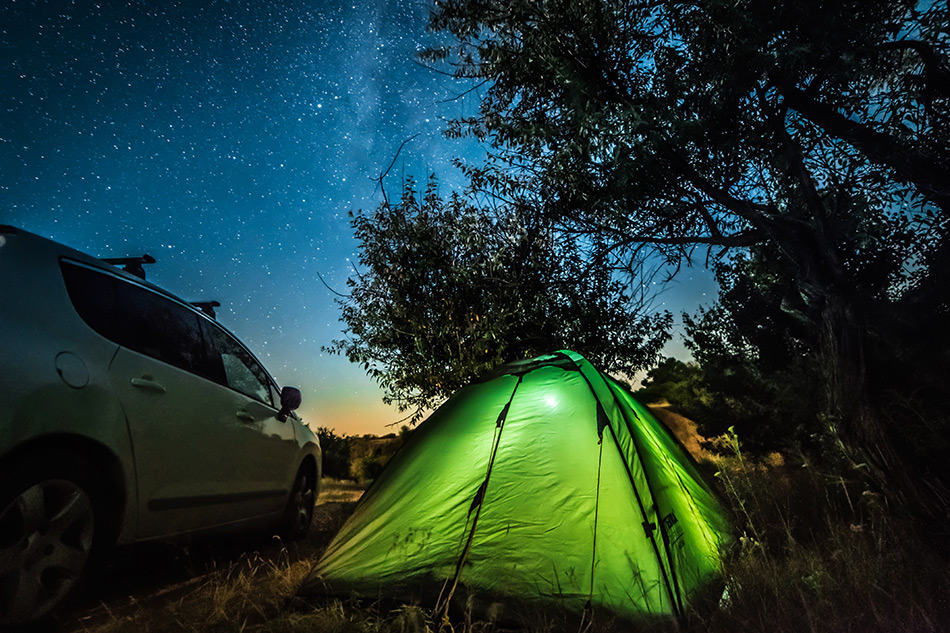
Camping in a tent beside car
Hipcamp has a lot of locations that allow tent camping

Harvest Hosts requires you to have a self-contained camper. This makes it off-limits to those traveling in pop-up campers or other small campers that might not have an indoor kitchen, bathroom, or other common areas that must be utilized outside the camper.

Hipcamp is totally different in this area. You will find locations that will allow anything from tent camping to large RV camping. Rather than being limited to having a self-contained RV, you can enjoy a camping stay while sleeping under the stars in your tent and enjoying an evening meal around the campfire.

Number of Locations

The number of available locations between the two services is a bit different. With Hipcamp, there are currently over 300,000 locations throughout the United States. These locations are made up of private property, campgrounds, ranches, vineyards, and more.

Harvest Hosts currently has around 2500 locations including wineries, farms, museums, and golf courses.

However, even though Hipcamp has a higher number of locations, some of them are only campground listings and not comparable to what you’ll find with Harvest Hosts.

If you are looking only for locations that will put you into unique places with stunning views and a memorable experience, the number of locations is considerably less.

Which is The Better Deal?

It’s hard to say which of these two services is the better deal because it will depend on different things. How much you visit and how much you spend will be the determining factor between the two. If you spend a great deal of money on purchasing products such as wine, farm goods, or other things offered by Harvest Hosts locations, you may end up spending more than you would if you had just booked a location through Hipcamp.

I prefer to have both options in my bag so that no matter where I travel to, there will likely be someplace that I can stay and enjoy.

You can purchase a membership through Harvest Hosts here and receive a 15% discount.

Sign up for Hipcamp using this link and receive $10 in Hipcash that you can use towards future trips.

Who is Harvest Hosts Best Suited For?

Glass of red wine and red grapes

People Who Like to Meet and Mingle With Others

If you have an outgoing personality or are just ready to talk with others and enjoy some company, this may be a good option for you. You will find yourself in wine tastings, beer tastings, and other events with others. You’ll probably meet others, make new friends and enjoy a good evening socializing with other campers. Not only that but you’ll enjoy talking to the hosts and learning about their business. It will be informative and fun if you enjoy the company of others.

People Who Drink Wine and Other Alcoholic Drinks

If you are not a drinker, you may want to pass on a Harvest Hosts membership. There are other locations but a large percentage of the locations are either wineries or breweries. Since you are expected to purchase something from the business, you may find yourself in an awkward situation if you do not drink alcohol.

People Who Like To Try New Things

Some of the host locations you’ll visit are off the beaten path and are places you would never go otherwise. Beyond wineries, you may find yourself at farms, unique museums, and other attractions. These locations give you the opportunity to truly try something new and take you beyond just the basic tourist attractions.

Who is Hipcamp Best Suited For?
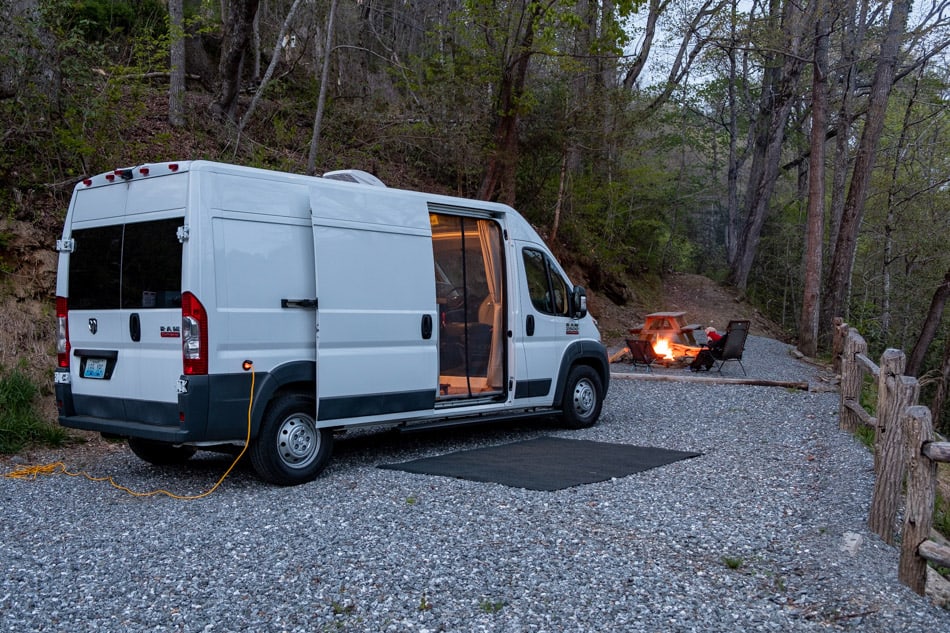
Sitting by camp fire at a Hipcamp location

People Who Just Want a Good Camping Experience

If your main concern is settling in for a great camping experience, Hipcamp has you covered. You won’t have to do anything except book your trip, show up, and enjoy! You can pitch a tent (in many locations), start a campfire, and enjoy your visit without worrying about any other obligations.

People Who Want to Be Left Alone

Once you are settled into a camping location, you’ll be left alone. It’s your time and it’s time to enjoy some peace and quiet while you make some truly unique camping memories. The Hipcamp locations that I have been to have given me a great experience and a peaceful getaway. A few of them even had me in locations where I never saw or heard another person the entire time I stayed there.

People Who Have Something Other Than a Self-Contained Camper

If you aren’t traveling in a motorhome or have another type of camper that is self-contained, Hipcamp locations usually don’t require it. Many places cater to any type of camper and it’s easy to see this information highlighted on the listing page.

Conclusion

Either of these options will give you a great camping experience that is something different than a standard campground. You’ll be able to find some stunning locations through both services. I have enjoyed many stays using both of these services and the majority of them have been absolutely wonderful!

9 Downsides of Van Life

Traveling in a camper van has its rewards but it can also have its downsides. There are some things that absolutely suck about living in a van! Even if you only travel in it for short periods of time, you’ll find these same pain points along your journey.

One might assume that living and traveling in a van is nothing but pure bliss with all the attention from social media and online videos. However, waking up in a picturesque place with everything staged for the perfect picture often requires a lot of miserable times to achieve. It’s not pure bliss every moment of every day and there are some adjustments to make in order to find happiness in the lifestyle.

Van life pictures don’t tell the whole story!

I don’t want to put anyone off to this lifestyle but there are some things that you should know if you are considering a van for yourself. There is always bad that always comes with the good. If you have tunnel vision and only focus on the good, you will probably be disappointed once you hit the road.

In this article, I’d like to point out a few things that often suck about van life or camping in a small camper in general. These are points that aren’t often discussed and may be trivial to some. Nevertheless, they are points that you may want to add to your list of negatives if you have a desire to pursue van life.

This is not to scare you away but only to help you plan better for your journey so you can better navigate the downsides of the lifestyle.

1. Everything Takes Longer

No matter what you do, it’s likely to take twice the amount of time that it normally would. Whether you are washing dishes, cooking meals, changing clothes, cleaning up, or making your bed, you can expect it to take longer than it would in a larger home environment.

I have found through my own experience that assuming things will take twice the amount of time is a good rule of thumb.

Of course, your results will vary but I have found this to be true for me as I have traveled around. Cooking is something that stands out the most. Because of such a small space, it’s not always possible to break everything out and set it on the counter as I would in my home. I have to do one thing at a time and in the end, it takes much longer to cook a full-fledged meal than it would if I weren’t in this mobile living situation.

If you are converting your own van or purchasing one, pay extra close attention to the layout. Make sure you can perform some of the main tasks efficiently rather than having a setup that takes forever to get things done.

2. It Gets Crowded With Two People

If you are going to camp in a van with another person or even travel for a small amount of time, you had better get along well with them. The limited space will have you bumping into each other constantly. There is a huge difference when I travel alone versus when I travel with my wife.

Alone, the space is plenty big and I can go about my business doing things the way I want. However, once she is present, it becomes quite a challenge to perform regular functions without getting in each other’s way. This can often lead to frustration.

Just know that you’ll get close and personal with whoever is in your van with you. You will want to make sure you have a great relationship and understanding with the other person you are traveling with. If you are fortunate enough to have a beloved pet traveling with you, the living space will become even more crowded.

This is all to be expected in such a small living space but you might not realize just how crowded it can get until you experience it.

3. It’s a Constant Battle to Keep It Clean and Organized

One would think that such a small space would be easy to keep clean. However, once you start coming in and out of the living space and actually using it, you’ll find that it can become a constant battle of keeping the living space clean and neat. If you are a neat freak as I am, you will be constantly at work trying to keep things put up out of the way.

Even when you build a van with plenty of cabinets and areas to accommodate clutter, it can still be a challenge to keep it clean and things put up in their respective places. Not only this but an unbelievable amount of dirt and debris gets tracked in every time you leave and reenter the van. It’s amazing to see how this builds up and you will find yourself sweeping the floor on a regular basis.

Whether it’s dust, gravel, twigs, or who knows what else, it will find its way onto your van floor.

4. Nearly Everything is a Hassle

I find that nearly everything I do in my van tends to be a hassle. It’s not that van life in and of itself is a hassle. The lifestyle and the freedom offered are amazing. However, I often find myself not doing certain things just because of the hassle involved. For example, I sometimes choose to cook a smaller meal than I want just because it’s so inconvenient to get a bunch of pots and pans out and then do dishes afterward.

Taking a shower or cleaning yourself up, filling water, dumping your toilet (if you have one), figuring out what to do with the trash, and the list goes on and on. Little things like this are really noticeable when out on the road.

5. Rain or Inclement Weather Makes Everything Worse

When rain or other bad weather situations are involved, the whole van life experience is made worse. Rain can put a damper on the fun experience of a van and even worse if you have a dog that needs to go outside often. When it’s raining outside, you may need to close all windows and vents making it a hot, humid mess inside the van.

When it’s raining, you’ll track mud and water into your van. You may be forced to sit inside your van with the windows and vents closed. The whole experience becomes worse so whatever sucked before, will suck even more with rain.

If you are in the snow, the same can be said. You’ll track snow, water, and mud into your van and it will create a mess that you’ll constantly have to clean.

6. Trash Constantly Builds Up

Trash gathers more quickly than you can imagine! Paper towels, cans, and other throwaway items will clutter your living space constantly. I am always amazed at how much trash builds up when I am on the road. Even when you cook all your own meals and try to be as mindful as possible, you will still find your trashcan becoming full way too quickly.

The main culprit for me is paper towels. I end up filling my trash can with them because they are so handy. My paper towel holder is over my sink and it’s easy to tear off a towel anytime I need to wipe something up. Food wrappers, cans, and bottles make up the rest of my trash. It seems like you are always having to look for a place to dump the trash. If you aren’t in a location where you can easily dispose of it, it will have to be stored in your van until you find a place.

Although not as wasteful as we are in our homes, the trash is right in front of you and more noticeable. As it builds up, it becomes more of a problem because there is no way to get away from it in a small living space. It will start to smell and take up space faster than you may realize. No matter how much you try to save on waste, it’s a constant battle to keep it dumped and clean at all times.

7. The Toilet Situation Sucks

Many vans don’t even have a toilet feature and many have a small portable toilet as I do. Many commercially available Class B RVs have wet baths with a cassette toilet built-in. Some may also have a composting toilet which is a great option if you have room and the budget for it.

However, no matter what type of toilet you have, you are in a small van. If you need privacy to use the toilet, the other person will need to leave to make it more private. This isn’t always possible and can definitely be a problem if you are traveling with another person. Both people may need their privacy and each person will need to leave as the other does their “dirty work.” This will be made worse when the weather is bad.

If you don’t have a toilet, you will have to drive around and find public toilets or dig a hole in the woods if you are boondocking. I can’t imagine not having at least a portable toilet in my van but many make do without one and only utilize public options.

All of these toilet options for vans are more challenging than what you will find in larger RVs that have bathrooms with dedicated waste holding tanks. This allows you to be further removed from the process and makes it more convenient.

8. Opening and Closing the Van Side Door Is Not Ideal

One thing I never really thought about when building my van is how bad the side door is on a Ram Promaster. It takes some muscle to slide the door and close it. I’ve greased and oiled the track many times but it still needs a lot of power to close it. I often dread having to close it when I’m in an area where others are camping.

Closing camper van sliding door

This will not be a problem if you have a fancier van with an auto-closing door. However, just be aware that a sliding door that has to be slammed shut can be quite loud. It often makes you feel like you are doing something wrong during quiet hours at a campground. Each time I slam the door, it seems to echo throughout the campground and I often get looks.

9. You’ll Feel Dirty and Nasty Most Of the Time

Between the lack of showering facilities and the often hot and humid living space and just the overall filth factor of being out and about, you’ll feel dirty most of the time. If social media posts and videos had a smell feature, you may be put off by the lifestyle. While people often look as though everything is just perfect, they are probably filthy from not having showered for days.

This isn’t always the case and if you have a shower in your van, you will be able to feel a sense of cleanliness at least some of the time. I have a shower in my van but since I’m often in water conservation mode, I tend to use it less than I’d like. It’s always nice to get to a place that has showers so you can take a long, hot shower.

Bottom Line

This is not an exhaustive list and is only some things I have noticed on my trips that I didn’t consider when first building my van. However, as I have traveled more and more, these are the same issues that come up again and again and make my trips a little less than ideal.

Not that any of these are deal-breakers, or even unexpected when you really think about it. It’s just that when you are in the market for a van or converting your own van, these tend to be things that are not on your mind and wouldn’t be unless you have been out in a van and experienced the lifestyle yourself.

If you are excited to convert a van, just keep in mind that some things aren’t going to be ideal and you’ll have to adapt and overcome. Expectations are likely the biggest thing here to consider. You should expect a little bit of give and take with this lifestyle.

Even though you’ll have an awesome little living space with many conveniences, it’s different than the space you have in a standard home. You’ll have to make some sacrifices, be patient and understanding if you expect to get the most out of your van.

Otherwise, van life is a super enjoyable lifestyle that can get you off the beaten path. It can give you the freedom to go anywhere you wish. The small size of the van gives it a leg up on other means of RVing and does have benefits in that regard. However, the small size also has these negative features as well.

Van Conversion Privacy Curtain – DIY Installation

Having a privacy curtain in your van is ideal for maintaining privacy but more than that, it can help ward off heat and make the place feel more like home. When combined with reflective window coverings, they make a great way to add an additional layer of privacy to your living space.

For my van conversion, I chose to install a privacy curtain between the cab of the van and the living area. I didn’t install it initially but after a few months of traveling without one, I decided one was needed. Once installed, I wished I had done it from the beginning as it makes a big difference in helping to make it feel like I’m in a little home rather than a vehicle.

Besides that, privacy is important and a privacy curtain does a darn good job of keeping your space private.

Now when I sleep in my van at night, I see darkness rather than the light pollution that gets in around the window coverings. The blackout curtain I used keeps it nice and dark so I can sleep with no strange lights.

In my van, there is a blinking security light in the dashboard that used to bug me. I would have to hang something over it so I wouldn’t see it during the night. Since installing the curtain, this is no longer an issue since all of the front area is now hidden when the curtain is closed.

Another benefit has been for using it during short periods of rest. As an example, when I pull into a parking lot to eat lunch, sleep, or just take a quick break, I can simply draw the curtain rather than installing the window coverings in all the front windows. It makes for a quick way to gain privacy when I don’t want to go through the trouble of putting my window coverings in.

Installing a Privacy Curtain in a Van

The following are the steps I took to install a privacy curtain between the cab of my van and the living space.

Choosing a Privacy Curtain

An ideal privacy curtain will be something that is made of blackout material that doesn’t allow any light through. With blackout material, the sun or other outside light will not be able to penetrate your van as much. Likewise, the light inside your van won’t be seen from outside if installed correctly and covering up all gaps.

It isn’t necessary to use a blackout curtain and any ole curtain will get the job done. However, for a better experience, I would highly suggest using a blackout curtain. This is what I chose to use and I was able to find one on sale at my local Kohl’s store.

The curtain was a bit larger than needed since it was designed to be installed in a home but my wife trimmed it up, re-sewed it to fit perfectly into the space that I installed it in. If you are not good at sewing or don’t know anyone who is, you can use some type of liquid stitching to make quick and easy work of customizing an oversized curtain. You can also pay someone to do this for you for a little bit of money.

Mounting The Curtain Rod

Curtain rod mounted on bracket

The most difficult part of the installation process, in my opinion, was installing the curtain rod. You probably won’t have a flat mounting area to install it like you would in a home. Because of this, you will probably have to be creative and this will look different in each van depending on how your ceiling and walls are installed.

Finding a curtain rod seemed difficult at first because I was overthinking it. In the end, I purchased a simple curtain rod from Home Depot that came with mounting brackets. The idea was to mount it to the ceiling and allow the rod to extend all the way across the van.

However, I also did not want to cover up the storage area over the cab. I wanted to be able to access this storage area while the curtain was drawn. In this case, the brackets that came with the curtain rod were not long enough to extend the rod down far enough.

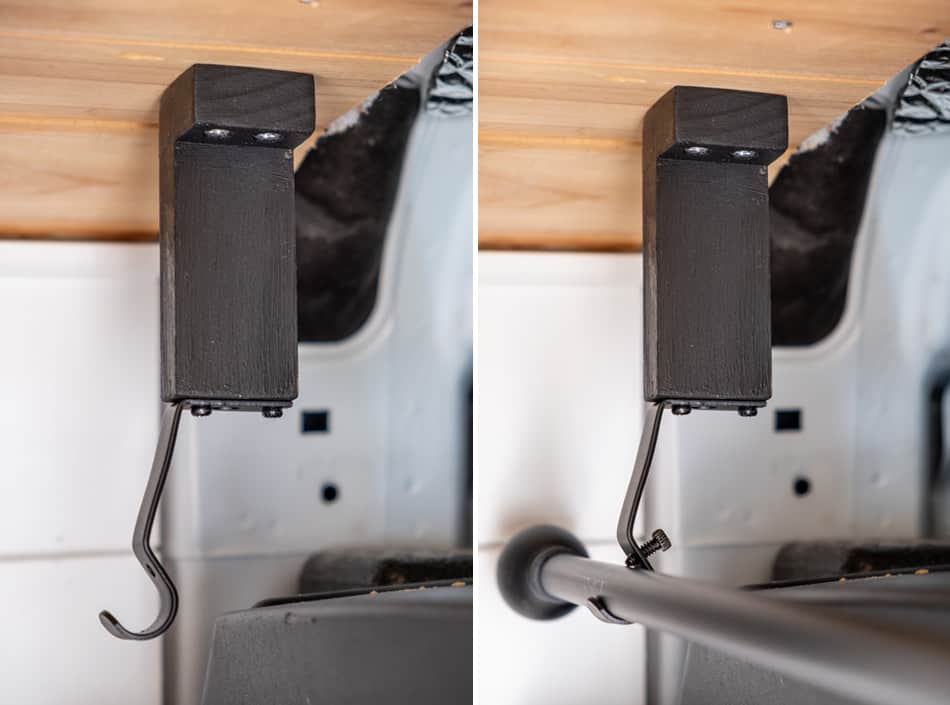
This is where a little DIY ingenuity comes in handy to complete the project. I created some very simple brackets that allowed me to extend the curtain rod brackets down from the ceiling a little further to exactly the place I needed the rod to be.

Curtain rod installed on hanging brackets

As you can see, this only required a couple of small pieces of 1″ x 2″ wood strips. I created two wooden brackets with flanges that would allow me to screw them into the ceiling. I painted them black to match the brackets that came with the rod.

Once the mounting brackets were screwed onto these wooden brackets, it looked as though it was all one piece when seeing it from a distance. It looks like it came this way.

Once installed on each side of the van, the rod simply sits in the brackets and the curtain easily slides back and forth, extending all the way across the living space. Each bracket also includes a small screw so you can tighten the rod into place once it is exactly where you want it to be. This solution works great and is sturdy without making noises as you travel down the road.

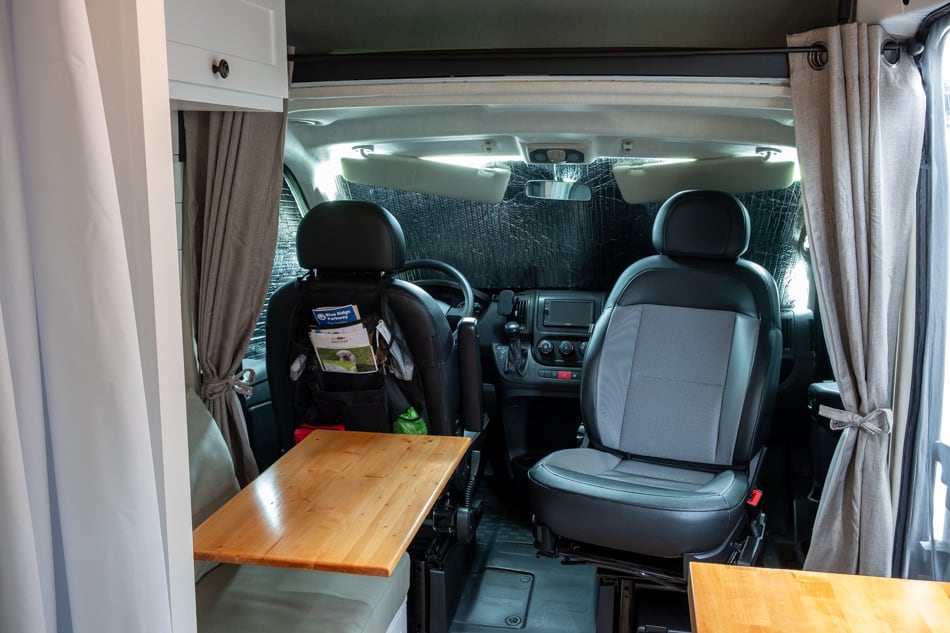
When the curtain is drawn, it provides good separation from the front to back and doesn’t allow any light in from the outside world.

Installing Curtain Ties

Opened privacy curtain

Once the curtain is installed, you’ll need a way to hold it open when you don’t want it closed. There are lots of different hardware solutions for this and it will depend on your van setup when choosing the best option. You may be able to screw some type of curtain ring into your walls on each side to do the trick.

For my van, each side of the wall where the curtains open up to is the plastic area that houses the airbags. There is no way I’m screwing anything into these areas. I chose a very simple solution instead: Velcro.

For this to work, you’ll only need some Velcro and some type of flat string. In my case, I used the extra curtain material that was cut off of the bottom of the curtain. My wife cut a couple of strips of the material and sewed them into strings that could be used to tie around the curtain.

Curtain ties attached to van wall

She also sewed Velcro onto the center of each string. With the other side of the Velcro stuck to the van panels, this string attaches tightly and stays in place at all times.

Velcro on curtain tie

When I’m ready to open the curtains, I can tie back each side so that they remain open and out of the way. It makes for a secure way to hold the curtains open and since it’s all cloth material, there is no rattling or noises as I drive down the road.

Van curtain tied to wall

Conclusion

Like most DIY projects I have done on my van, this privacy curtain gave me a real sense of satisfaction once installed. I put it off for far too long and have certainly appreciated the benefits it has brought to the experience.

  1. It creates a more private experience. It gives me a greater sense of privacy because the window covering in the front windshield has areas where people can see in, especially if the interior lights are on. The curtains helps fill in the gaps.
  2. It helps to manage heat. It provides an additional layer of radiant heat blockage from the front window area. While not life-changing, it is noticeable.
  3. It makes for a better sleeping experience. My van is now super dark at night with no stray lights coming in through the front of the van.
  4. It gives your van a more homey feel. It keeps the steering wheel and front seats out of sight so you don’t feel like you are sleeping in a vehicle.

This was a project that I initially avoided because I couldn’t figure out how to mount the brackets for hanging the curtain. I have a tendency to overthink projects like this. There are other ways, and probably better ones, to hang it beyond what I have done but hopefully my method has given you an idea to help you install one in your van.

Thetford Porta Potti 565e Review

The Thetford Porta Potti 565e is the flagship model of the Porta Potti series made by Thetford and is one of the most premium portable toilets on the market. It has all the bells and whistles available on it and makes for a premium camping experience or a great way to have a full-featured toilet anywhere you go.

This toilet offers a few features that none of the other offerings do. While all of the Porta Potti series toilets are great products, this one is a step above the rest. If you are looking for something that doesn’t feel like a portable toilet and more closely resembles the one you use in your home, the 565e may be the one for you.

I have owned the Thetford Porta Potti 365 toilet for a few years and it has always served me well in my van. However, I recently had some issues that were covered under warranty with it and Thetford was kind enough to upgrade me to the 565e model.

Having used this toilet now on a few trips, I would like to give you my view on whether this is a good purchase and worth the extra price you’ll pay.

Features & Build Quality

In keeping with all the portable toilet models that Thetford offers, this one is made from high-quality plastic. You know you are getting a quality product with the feel of the product and parts on it. I have used and reviewed other toilets that aren’t at the same level of quality as Thetford Porta Potti’s are known for.

Let’s look at some of the best features of the Porta Potti 565e.

FeatureNotes
Large toilet sizeHeight 17.6″, Width 15.2″, Depth 17.7″
Large capacity4-gallon freshwater, 5.5-gallon wastewater, 56 average flushes
Electric flushLove it or hate it, it makes easy work of flushing the toilet (more on this later).
Integrated toilet paper holderThis makes a handy place to store your toilet paper.
Fresh and waste water gaugeKnow where you are with capacities at a glance with multiple gauges.
Carry handlesTwo carry handles make it easy to carry from place to place.
MountableKeep it sturdy in your RV or moving vehicle with the optional floor bracket.
Larger comfortable toilet seatWhile not quite as comfortable as a home toilet, it’s the best I have seen on the market on a portable toilet.

These features are above and beyond what you generally find on portable toilets making it an upgraded version in most cases. Some of the more common features that it has and you can expect on any portable toilet include:

  • Small and portable
  • Swiveling, no-splash waste holding tank dumping spout.
  • Seal between fresh and wastewater tanks so it doesn’t smell.

In my experience, these types of toilets don’t smell if maintained and used properly. The seal works great and if used with proper chemicals, you’ll never have to worry about these types of toilets smelling up your living space.

Using The Thetford Porta Potti 565e

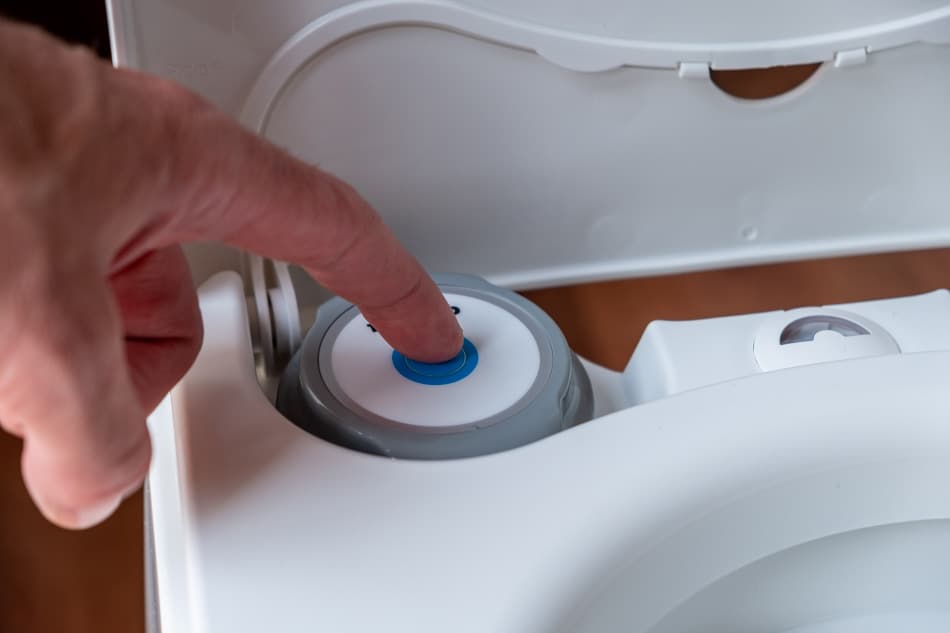
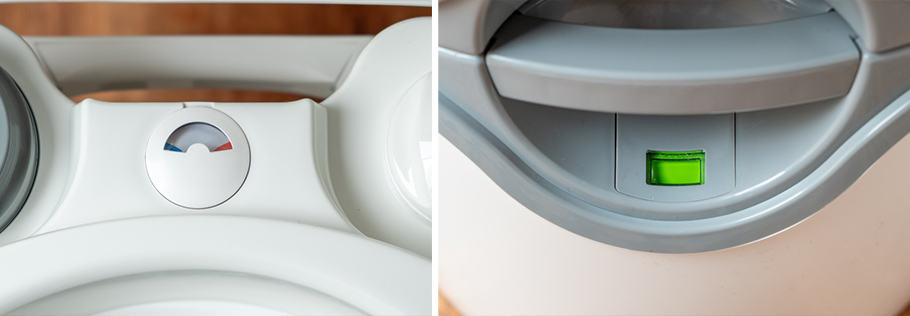
Push button electric flush

Just like most of these types of portable toilets, the 565e works much like the toilet you have sitting in your home bathroom. The only difference is that you’ll have to manually fill the water bowl and the waste process is not completely out of sight and mind like in a normal plumbing system.

When using this toilet, you’ll first fill the bowl with water using the electric button. Once the water is at the level you prefer, it’s time to do your business.

Once finished, you will then pull the blade handle on the side of the toilet allowing you to flush everything down into the waste holding tank. Once it has all been flushed, the blade handle can be pushed back into its closed position. This will allow the waste holding tank to be sealed off and out of sight until it’s time to dump it out.

Dumping The Toilet

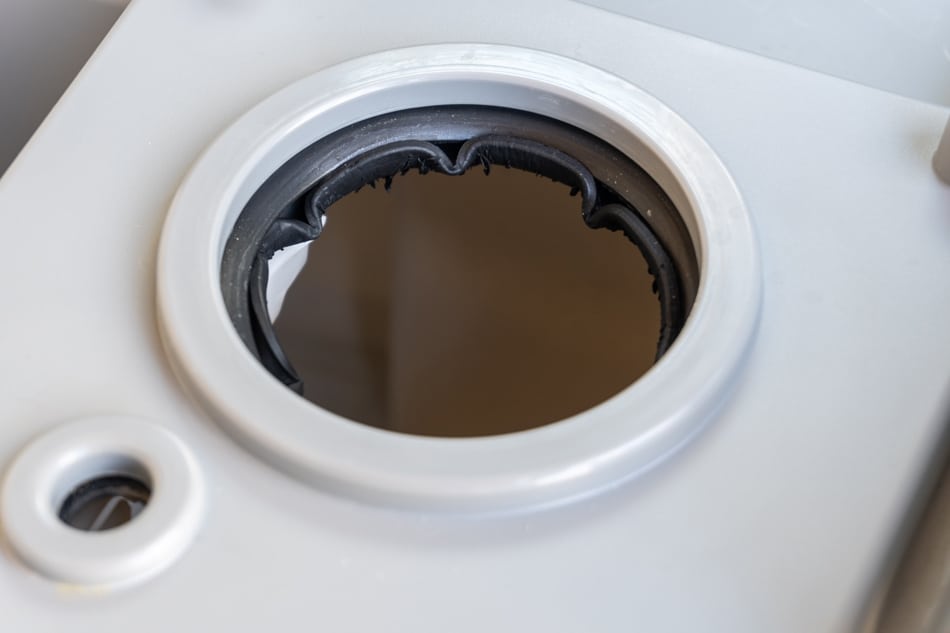
Once you are in a location where you can dump the tank, you can remove the sealed waste tank and dump it into an approved dumping area. Dumping is made easy with the rotating pour spout. You can aim it where you need it to go and dump it out with no splashing or mess.

Although not quite the hands-off experience you may be used to in your home, it makes a great solution in a mobile living arrangement.

Some toilets don’t have this type of swivel spout on them and only have an opening directly on the waste tank. These are messier to dump in my experience and you have to be a little more careful.

Pros

Large Comfortable Seat

If you are looking for a toilet with more of a standard size seat, the 565e will do the trick. It’s about as close to a standard-sized seat as you will find in a portable toilet As you can see in the picture below, the seat has a wide surface area making it more comfortable than smaller seats on the market.

Thetford Porta Potti 565e toilet seat top view

The comfortable size of the seat is a welcoming experience, especially for larger or even average-sized adults. Anything less will likely feel a little small for most people.

Large Seat Opening

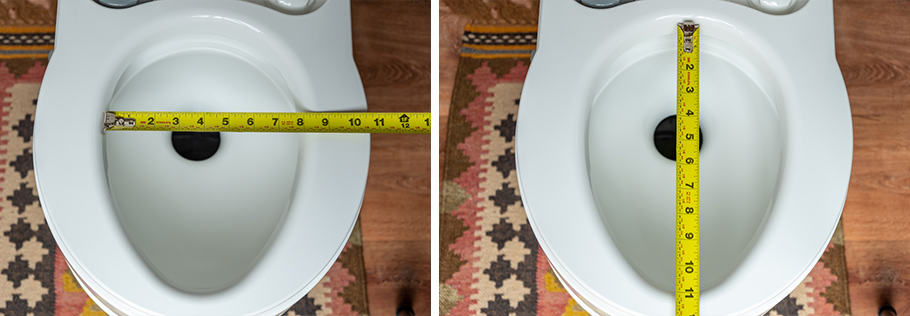
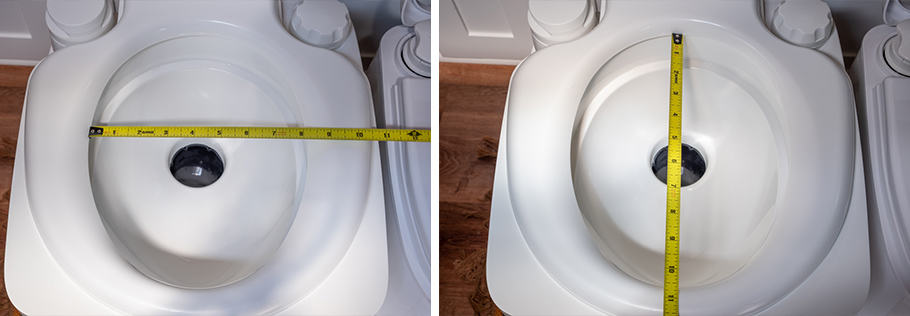
Besides the seat itself being comfortable, Thetford has also been generous with the seat opening. The seat opening on this toilet measures in at approximately 7 3/4″ wide x 11″ deep. This is larger than what you will often find in portable toilet options.

Thetford 565e toilet seat opening measurement

Some of the popular toilets on the market have a smaller opening than what this toilet has. In my experience, Thetford has made their toilet seat openings larger to accommodate adults. This makes it a comfortable option if you require a larger seat opening. It just feels better sitting on this than it does on one of the smaller options.

As an example, the Dometic toilet that I recently reviewed has a smaller opening, making it feel too small for an adult to use on a regular basis.

Smooth Flushing System

Flush handle on side of Thetford 565e

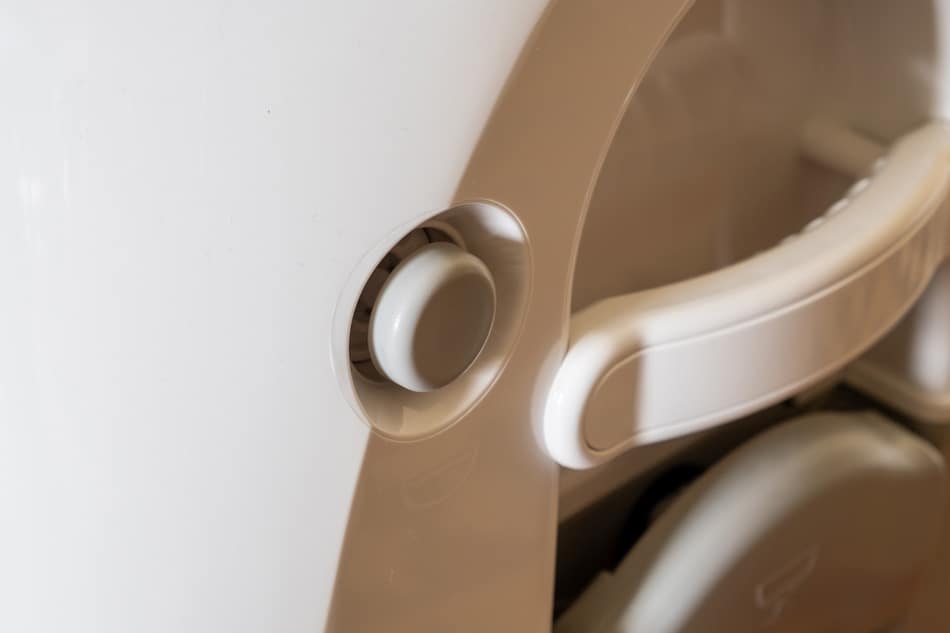
The flushing system on the 565e is a simple process and of course, made easier with the electric flush. The first step in flushing the toilet is to pump water into the bowl. You simply push the electric flush button and water will flow into the bowl.

Once you have relieved yourself and are ready to release the waste into the holding tank, the blade handle on the side can be opened to allow the water to go down into the holding tank.

Many toilets have this same system but the blade handle is usually located in the front of the toilet. Your legs are in the way of this so you will usually have to stand up to flush. This toilet allows you to accomplish this while still sitting down if you wish.

This works perfectly for my solution and where my toilet is located but some people may experience an issue with not enough space on the sides. In this case, one of the front flushing models may work better.

Gauges Galore

Multiple gauges on the toilet

Many toilets on the market have a gauge on the waste tank to let you know when it is full. However, the Thetford 565e goes one step further and also has a gauge for the freshwater tank. This is a much-appreciated addition and helps to ensure you don’t run dry when least expected.

In my Thetford 365, I had to guess when it was close to empty and sometimes it would run low to a point where air started sputtering out when you work the pump. A gauge is nice to have so you can have a quick visual of how much water you have left at any given time.

This is a nice addition to this toilet that most don’t offer.

Nice Modern Look

Like most of the Thetford toilets, they have created a nice modern look that goes well in a camper without creating an eyesore. With its neutral color, it’s easy to include this toilet into any decor so that it blends in well.

Integrated Toilet Paper Holder is a Nice Touch

Toilet paper holder with roll of toilet paper on it

One of the handiest features for me is the toilet paper holder. Before having this, my toilet paper got placed all over the van. I never knew where it would be when I needed it. Since I had nowhere to keep it in my toilet area, it usually ended up in a cabinet and out of the way just when I needed it the most.

With the 565e, the toilet paper is always tucked away in its dedicated toilet paper holder. I can simply reach down on the right-hand side of the toilet and grab some paper at any time. This gives me a much better experience and helps me keep things neatly into place at all times which is very important when traveling in a small van.

Cons

Expensive

It’s one of the most expensive portable toilets on the market. While the quality is great and it’s definitely worth the asking price, if you are seeking a more affordable option, there are other toilets out there that may work better for you.

Electric Flush With No Backup

Electric flush batteries

I like the electric flush on this model but I would prefer a manual pump flush. They do have a manual pump version of this toilet available but it seems to be only available to the European market.

It would be nice if the 565e had a backup manual pump option. It should include something like this in case you are out camping and your batteries die or the electric parts just stop working. If this were to happen on your camping trip, you would have no way of getting water into the bowl other than pouring it in manually from another source. As far as being able to pump water from the freshwater tank into the toilet bowl, you’d be out of luck.

I would prefer the manual version so I wouldn’t have to fuss with the batteries. The electric pump holds 6 AA batteries (which the toilet comes with). I’m not sure how long these last as they have been working well for me so far. You could use rechargeable batteries to save yourself from being completely dead in the water if you are out boondocking.

The Electric Flush Pump is Loud

When you push the pump button, it makes an electric pumping noise that is louder than the manual version. With the manual pump I had on my 365 model, I could pump harder or softer depending on what I needed. The softer you pump it the quieter it is. If you are up in the middle of the night and someone else is sleeping, you can pump it softly and barely even hear it.

With the electric flush, there is only one speed of flushing: wide open! When you push the button, it’s the same sound each time. It’s also the same amount of gushing water coming out each time which you could control better with the manual pump. If you pump the manual pump harder, it pushes the water out harder allowing you to clean the bowl better.

Thetford 565e vs 565p

The 565e is the electric flush version whereas the 565p is the manual pump version. Both are the same toilets but utilize a different flushing system. As mentioned above the electric flush can have its downfalls especially if the batteries die while you are out in the middle of nowhere. While the 565p isn’t as fancy with its electric flush, it gives you a way to flush the toilet without being concerned with batteries.

It would be great if they could combine these two toilets, making one toilet that has both types of flush systems. Electric as the main way but a manual pump as a backup. This would perhaps make the ultimate portable toilet.

Bottom Line

The Thetford Porta Potti 565e is definitely the toilet to have if you want to experience the top-of-the-line quality no matter where you are. There are many models on the market but the 565e has proven to be among the best ones. If you have the space for a larger portable toilet and you have the extra money to spend on one, I would suggest this toilet over some of the smaller ones you might find.

With the Thetford 565e, you’ll have access to a convenient and comfortable toilet experience no matter where life takes you or how far you travel.

Van Conversion Water Heater – How To Install

If you are converting a van, having hot water is a true luxury that many overlook. The reason is obvious since a water heater either uses a lot of electricity or must be connected to propane. In either case, it often presents an installation problem and becomes something that is better just being without.

After all, there are other ways that you can have hot water in your van without having an actual water heater. Furthermore, a water heater may not even be necessary unless you have a shower installed. In this case, having hot water can make or break the experience. Taking a cold shower is not fun even during the dog days of summer.

When I finished building my van, I put off installing a water heater and just used my shower with cold water. However, this was no fun and especially during some of the best times of the year. During the spring and fall when the weather is perfect for traveling in an RV, the water can get quite cold when the temperatures are nice and comfortable at night.

As an avid hiker and biker, I would often be dirty and sweaty from a day out on the trail. It’s nice to rinse off in the shower after this type of activity. A cold shower though? Well, I’ve taken many of them but there is a point when enough is enough and the time had come to install a water heater in my van.

Installing an Electric Water Heater in a Van

Water heater in van wide view

If you plan on installing a water heater in your van, the best option is to get a qualified plumber to do the job. I opted to do it myself since I have done quite a bit of plumbing work and have all the tools I need. I plumbed my entire van system so installing an electric water heater was a walk in the park. If you are not comfortable with this type of installation, I would highly recommend getting a professional on the job.

With an electric water heater, one thing that you’ll want to make sure of is that you have an electrical outlet capable of providing the amperage required for it to operate safely. You’ll also want to make sure you have a powerful solar system or a way to connect to shore power.

I chose the Bosch 2.5 gallon water heater. It uses 1440 Watts at 120 Volts which amounts to 12 Amps. This model has become a popular model mainly because of its small size and low electricity needs.

A typical 15 Amp plug would be fine for this particular water heater. Mine will only be used when I am connected to shore power so I won’t have to drain my solar battery bank to heat water.

Once you have determined that you can meet the energy needs of the water heater, you’ll need to figure out where to install it. You probably already know where this will be and have a location for it. If you have a setup with a fixed bed in the back with a storage area underneath, this space will work perfectly. This is exactly where I installed mine.

Ideally, you’ll want to place it as close to your water source as possible.

Be sure and install this solidly so that it doesn’t move around while driving. The wall mount that came with the Bosch heater is only a bracket that the heater hangs on. It isn’t very secure for a moving vehicle so I added some hooks to the area where I mounted it in so that I could cinch it down tightly with ratcheting straps. It doesn’t look great but it keeps it tight and in place.

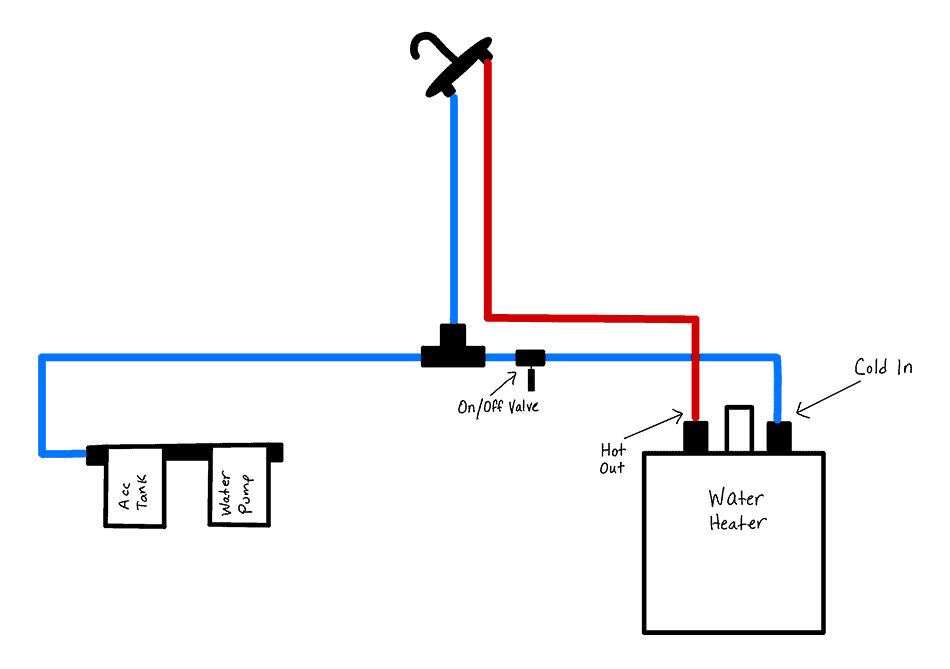
Next, you’ll want to determine exactly how you’ll plumb it into your system. This may take some planning but the best way that I have found to sort this out is to draw out a simple diagram. The following diagram is what I sketched when I was planning how to add this water heater to my system.

Van conversion water heater diagram

Using the diagram above, these are the steps I took to fully install my water heater.

Step 1

PEX splitter for water heater

You’ll need to split the cold water coming out of the water pump or accumulator. Once your piping has left this water source area, the cold will need to continue for the cold side of your faucets. The other side of the splitter will connect to the cold side of the water heater. I installed an on/off valve for this side so that I could bypass the water heater altogether when not in use or when driving.

Step 2

Hot and cold water connections on water heater

Once the cold water line has been connected to the cold side of the water heater, the hot water pipe will exit from the hot water side. This is what you’ll run to the hot side of all your faucets.

Step 3

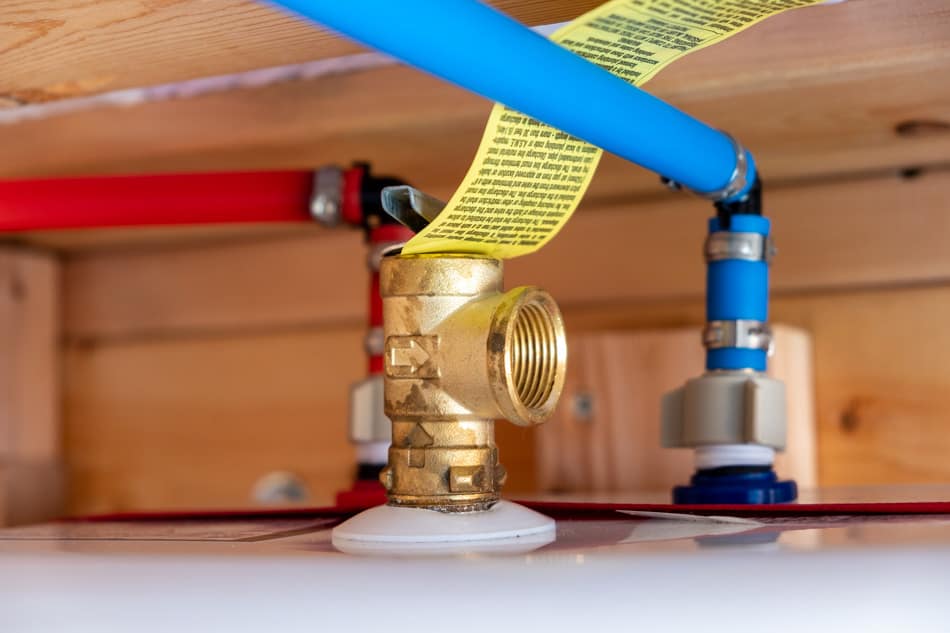
Overflow valve on water heater

Extend the pressure relief valve to an outdoor area or waterproof floor pan. This valve is located on all water heaters. It’s important for expelling built-up pressure and keeping you safe. It’s a good idea to extend this valve to the outside of the van so that any expansion pressure has a place to escape. If you leave your water heater on at all times when you are parked, you will want to connect this. It can be run through the floor of the van so that any expansion leakage will be dripped onto the ground.

I only use mine occasionally to take a shower so I chose not to connect this for now. My water heater is only turned on for the amount of time it takes to heat water and take a shower.

I did, however, place my water heater into a waterproof container so that any overflow or leaks would be contained rather than leak or spill out in my van.

I took this precaution throughout my whole water system and made sure I had a safe, waterproof area underneath my water tank and shower pan as well.

Using PEX to complete the connections, as long as they are connected correctly, shouldn’t give you any problems. These connections are solid and I have never had any issues with leakage. Just be sure and purchase a proper crimp tool to complete the job.

Crimping PEX fitting

Once installed, you can simply plug it into a shore power connection or solar connection if you have plenty of amps to push it. It takes about 15-18 minutes to fully heat the 2.5 gallons in the tank. Once heated, you can take a quick shower, wash dishes, or whatever you need to do. I have found it to be plenty of water to take a quick sailor’s shower with.

Taking a quick shower will ensure that you have enough hot water and won’t leave you finishing up with cold water. Once complete, you can simply unplug the water heater as it is no longer needed. This is what I do in order to save electricity.

One thing to note about this type of water heater is that you can heat the entire tank, unplug it and the water inside will still be hot even after a full day. This is especially true in the hot summer temperatures. You can potentially heat the water while you are parked at a campground and then take a warm shower the next day when you find yourself boondocking without electricity.

Other Ways to Heat Water in a Van?

If you haven’t yet decided to install a dedicated water heater in your van, there are plenty of other ways to get hot water. I used a few methods myself before I installed mine and still do on occasion when I am off the grid.

Stove Bath

With a stove bath, you can heat a large pot of water on the stove, then combine it with cooler water to create a warm bucket of water. It helps to have a large container to use for this, preferably one that collapses in order to save space.

With this warm water, you can splash yourself off and clean the important areas when in a pinch. It can be done outdoors and it also works great if you have a shower in your van or an area where you can splash water around.

If you are looking for a little hot water to wash dishes, you can also use this same technique. Just heat the water on your stove, then pour it into a sink so that you will have warm water to wash dishes or clean your face, etc.

Outdoor Sun Showers / Heaters

These types of showers provide a simple way to enjoy a warm shower, even when off the grid. In order for them to be most effective, you’ll need some warm sun to heat the water throughout the day. If there is no sun and it’s mostly cloudy, you may be out of luck with warmth but you’ll certainly have water.

There are different types but usually are available in hanging bags or tubes that ride on top of your van. The water contained inside gets heated by the sun and when you are ready to use the water for a shower, gravity does the work of providing the water flow.

Propane Water Heater

If you prefer an outdoor shower that can tap into propane, a propane camping water heater is the way to go. These are designed to be used outdoors only in a camping environment and are not intended to be used in closed quarters. The CampLux Water Heater is a great option.

However, if you are parked in the boonies and have your privacy, these types of water heaters can provide a great way to have a nice, warm outdoor shower.

Bottom Line

After all is said and done, I prefer an electric water heater for those times when I just want to take a quick shower. It’s an easy installation and it’s a quick and easy way to get hot water when you need it. While you will have to be plugged up to shore power, most likely, I find that I am often in an area where I use shore power anyway. Having this electric water heater has been a game-changer for my shower.

Before having this water heater, I took cold showers when needed. Finding myself sweaty and stinky after a long hike, taking a cold shower isn’t so bad. However, even in hot summer temperatures, the water can sometimes be so cold it takes your breath away. The water heater is just another way to bring the comforts of home to a van that can make your life convenient while out on the road.

Is Camping Good For The Environment?

Camping is a fun and exciting way to enjoy the great outdoors. It can also be an environmentally friendly way to travel and enjoy some much-needed time off, with minimal impact on nature. However, this doesn’t mean that everything about it is environmentally friendly. There are some things that you should know before you just assume you are being a good steward of the Earth just because you are camping.

Camping can be a good way to get up and close with nature, allowing you to garner appreciation for the beauty that we have in front of us. This alone can create a habit of good stewardship towards the Earth and the valuable resources we have which can have a positive effect on the environment.

While some might see camping as an invitation for people to mistreat natural resources, others argue that camping has a positive effect on nature because of the appreciation gained from the experience.

Both points are valid and I have seen my share of people in both camps along the way on my journeys. Most of us who camp are respectful of the natural environment. However, there are times when you will run into those who just don’t care! They leave trash, dump things they aren’t supposed to, and live as if their fun experience is all that matters.

These people are few and far between thank goodness but it goes to show that not every camper is out there benefiting the environment. With that being said, let’s look at some of the ways camping may have a positive effect on the environment.

Reasons Camping is Good for the Environment

1. It Makes You Appreciate Nature

Nature is full of wonders that are revealed when you stop and take time to notice. Whether it’s insects crawling on a leaf or wildflowers pushing their way through thick underbrush. From an amazing, colorful sunrise to a starry night sky. It’s hard to go on a camping trip and not see something that you wouldn’t have seen otherwise. It gets you up close and personal with the natural world and often leaves you in awe of the experience.

This can bring a new appreciation to the world around us. Without these excursions, you may only experience a concrete world of consumption rather than just slowing down and taking the time to breathe, relax, and just enjoy what’s already here.

Ultimately, this leads to people who have an appreciation for the great outdoors and over the long term could be beneficial. The more people that experience this type of lifestyle, the more will see how wonderful it is and it will cause more to understand that we have to appreciate and protect it for future generations.

2. Minimal Supplies Are Used

When camping, you usually take minimal supplies which create less waste than you typically would in a normal living situation. This alone can be beneficial to the environment because there is less waste that needs to be disposed of after the trip.

Many people camp with just a few items that can fit in their backpack or car. Campers usually need only some food, water, matches or lighter, a tarp, tent, and sleeping bag.

For those who camp in RVs, the RV itself is a large item to acquire and use but it probably isn’t loaded with supplies like your house would be. Because of space, you are likely to carry less and be more considerate of the items you have in it.

Of course, this may not be the case if you bring and use throwaway plastic utensils, plates, cups, and other items for convenience. The key to having a great camping trip is less stuff and more experience. Rather than plastic throwaway junk, opt for reusable stainless steel products or higher quality plastic items that might last for years to come.

3. It Makes You More Conscious of Waste

trash can hanging on side of RV

We live in a throwaway society but when camping, you realize just how much waste you are actually creating. This is front and center since the waste you create has to be carried out and disposed of. This will make you more conscious of just how much waste you are creating. I’m well aware of the waste I create when in my van as it fills up faster than I usually want it to.

This makes me even more conscious of how much waste we humans create in our normal lifestyle. Even when trying to be less wasteful, the trash can piles up at an alarming rate!

It’s likely that most campers generate less waste than a typical consumer lifestyle would permit. In the end, this is a good thing since it puts less of a strain on our environment.

4. You Use Less Electricity

When at home or in a typical living situation, we typically use a lot of electricity for things like air-conditioning, heating, stoves, ovens, lights, televisions, and all kinds of other electronic equipment. Compare this to a camping environment where electricity needs are considerably less.

Camping allows us to get off the grid at least a little bit. While we may still connect to the grid, we don’t use quite the amount of energy as we would at home.

Imagine if everyone lived this way? If everyone were utilizing less energy, it would be much better for the environment. When you are on a camping trip, it makes you feel good to be living more primitive and having less electrical needs.

If you are like me and have solar energy in your RV or other camping setup, you can have the best of both worlds. You can have electricity while harnessing it all from the sun. This provides you with energy without the pollution that usually comes along with it.

5. You May Drive Less

Camping allows you to set up your camp and not have to drive so much. You usually don’t need to drive at all, and if you do, it’s only a small amount of miles. This may actually help reduce your carbon footprint! The less you drive, the less fuel you are going to use.

Of course, this will also depend upon the type of camping you are doing. If you are traveling long distances in a Class A RV, you are going to drive a lot and use a lot of fuel. However, if you are going on a weekend camping trip to a location and setting up your camp, you are likely there to stay.

6. It’s a Respectful Community of People

The one thing that connects all campers is the love of nature. People who are passionate about important issues like environmental conservation often have strong ties to the outdoors. These people often have respect for the beauty that they so love. This makes it easy to relate to others while out on your journeys.

You’ll often notice that other campers tend to take notice of environmental concerns and will do their best to do their part in keeping our lands in good shape. It often makes me proud to be among others who understand the amazing world that we live in and try their best to do their part.

7. You Use Less Water

Water needs are less when camping simply because you might not have an unlimited supply of it. If you are tent camping in the wilderness, you probably only have what you brought in with you. Beyond that, a stream or lake may be your only source with the help of a good water filter.

I have a water holding tank in my van that is 16-gallons plus an additional 2.5 gallons in my hot water tank. I know that I have this limited supply when I am on a trip. It makes me very conscious of just how much water I am using. I am often amazed at how little water I actually need. When compared to the amount I often use at home, it makes me feel good.

Reasons Camping is Bad for the Environment

1. People Leave Trash

Campers often take shortcuts when it comes to camping, such as packing disposable utensils instead of carrying their own set, or leaving the trash behind instead of carrying it with them.

By doing this, campers are polluting our forests, our bodies of water, and our air by leaving behind their trash. This also means that they don’t enjoy the beauty of nature as much as more responsible people.

It makes me so mad when I get to a location and see trash lying on the ground from previous campers. It makes no sense that people who would spend time enjoying nature would then dispose of items in such a way that is damaging to that very nature.

It’s people like this who ruin it for others. They pollute our lands and have little respect for anything other than their own enjoyment.

Unfortunately, these people make it to campsites and end up doing more harm than good. If you have spent any time in the great outdoors frequenting campsites, there is no doubt you have seen trash left behind from these inconsiderate people.

2. RVs Use a Lot of Fuel

No matter what type of RV you have, using a lot of fuel is just something that you will have to get used to. Even though some RVs get better fuel mileage, such as a camper van, most of the time these vehicles will be loaded or going up and over mountain passes which will require more fuel than a passenger car.

It’s hard to say that something is environmentally friendly when it is causing damage by using fuel and off-putting carbon dioxide. If you are trying to shy away from producing so much carbon, driving an RV may not feel right to you.

3. Generators Create Pollution

Starting a generator next to an RV

Beyond the fuel used to power your RV or other vehicle, generators are often used to provide electricity. These gas generators output pollution as well and can contribute to the problem even more. Not only that but generators create a noise problem especially when other campers are around trying to enjoy a peaceful night.

It’s a little annoying to pull up to a Camping site and hear a generator running from someone nearby. This is especially annoying as it goes on throughout the night. While most RV parks have a time limit on these types of generators, many do not.

4. Social Media is Having a Negative Effect

Since everyone posts pretty much every action they take nowadays, social media networks have become overwhelmed with people doing amazing things all over the world. No longer are these locations secret but have become popular attractions for others to explore. This has invited everyone to freely explore them which unfortunately has repercussions.

Places that used to be perfect nature are now trampled and littered by some of the inconsiderate types of people mentioned above. It’s probably others who are looking to get those social media shots as well. Rather than simply enjoying it for themselves, they have some strange need to show everybody in the world what they are enjoying.

Call me old-fashioned but I travel in my camper van so that I can experience nature at its finest in the locations that I go to. I prefer not sharing any of my locations and would like to keep them for myself to explore.

5. Camping Equipment Is Needed

No matter how well you go about protecting the environment, you are still a consumer of the needed equipment to take you places. Unfortunately, the manufacturing of most of this type of equipment is not done sustainably. With many camping products being made with synthetic fibers, plastics, and other types of materials that have an impact on the environment, it creates a conundrum for those who want to enjoy camping but are concerned about the products needed.

6. Wildlife May Be Affected

Elk standing in crowded campground

The further we humans reach into the wilderness, the more we affect the inhabitants of those wildernesses. The wildlife has already been pushed from their homes with our city streets and other man-made objects stretching the globe as far as the eye can see. Wildlife is important for our ecosystem and each time a commercial RV park or other campground encroaches on an area where wildlife lives, it isn’t good.

Of course, this is hard to avoid with camping becoming more popular and the population becoming larger. There are simply too many people on this planet and unfortunately, wildlife is often seen as nuisances rather than the deserving occupants that they are.

Conclusion

Camping is a double-edged sword for those who have a desire to maintain an environmentally friendly lifestyle. While slowing down and camping with minimal gear and impact on the earth can be beneficial, it can often have adverse outcomes as well.

The best you can do is the best you can do so it’s important to educate yourself on decisions regarding your camping trips. Make sure that you are doing all that you can to stay environmentally friendly as much as possible. We all need gear and driving is just a part of life.

Hopefully, these types of things will become better over time and as long as you are doing your part and taking care of things that you have control of, camping can be a beneficial part of maintaining the planet on which we live.

How Well Do Rivet Nuts Work?

Rivets nuts are a popular way to fasten bolts to thin metal or other materials. These can be installed in order to create a threaded location for inserting bolts. I used Rivet nuts throughout my van conversion and have experienced the good and the bad along the way.

Rivet nuts work very well in certain situations and can offer a strong, secure hold that won’t vibrate loose. They work great when you only have access to one side of the material. You can simply install them securely from one side without having to touch the other side.

Once installed, you simply screw your bolt in tightly as you would in any threaded bolt hole. If you are converting a van, there are numerous holes throughout a cargo van that you may be able to utilize. You can simply purchase the correct size of Rivet nuts to install in these holes giving you places to bolt to without creating new holes.

Rivet Nuts For Van Conversion

Whether you are converting a Sprinter van, Promaster, Transit, or any other type, chances are there are holes already in place throughout the cargo area. Some of these holes can be utilized so that you don’t have to drill new ones. Many people use self-tapping screws to hold the ceiling, walls, and other items to the metal van framing. However, these require you to drill and screw directly into the metal, creating new holes in the process.

Either way is fine but using Rivet nuts can give you a clean and sturdy bolt hole in which to thread items into tightly.

The following image shows some of the pre-drilled holes in my Ram Promaster.

Holes in metal of cargo van interior

There are various sizes throughout a van but the most common sizes in the Promaster van are:

  • 1/4″ 20
  • 5/16″ 18
  • #10-24

You can purchase them in different materials including stainless steel. I chose to use mostly stainless steel ones but it really doesn’t matter in the case of a van conversion since they won’t be directly affected by the weather. If you want to be extra cautious and prevent corrosion from happening over the long term, I would suggest using stainless steel.

What is the Best Rivet Nut Tool?

If you are installing Rivet nuts, I would strongly suggest a proper tool for their installation. It may be an extra cost in the beginning but it will save you so much time and headache. Not only that, you’ll be confident each time that they are installed correctly. There are many tools on the market with each being similar in the way they function.

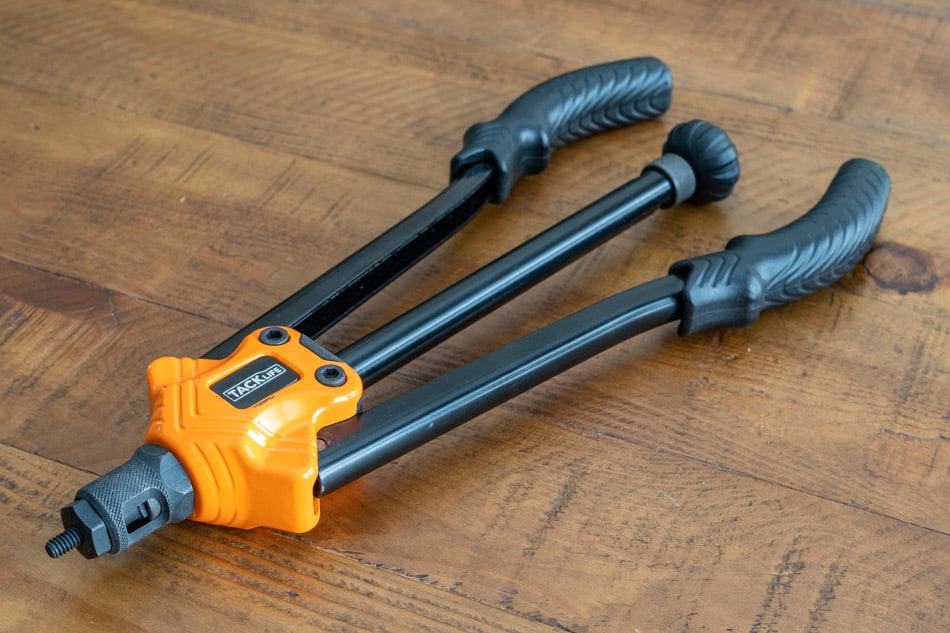
Tacklife Rivet Nut tool

I own the TackLife Rivet Nut Tool and it has been a great tool that works well. This tool makes quick work of the process.

You can install these without a tool by using your own DIY solution but I wouldn’t recommend it. It’s more difficult to do, takes longer, and doesn’t produce as good of results as using a tool that is made for it. If you are set on doing it without a tool, this video will show you exactly how it’s done.

I tried going this route at first but decided pretty quickly that purchasing the right tool would be the way to go. If you are only installing a few of these nuts then a homemade solution will work fine. However, if you are using dozens of them throughout a van build and want to make sure there is a consistent installation, a tool is the way to go.

Installing Rivet Nuts

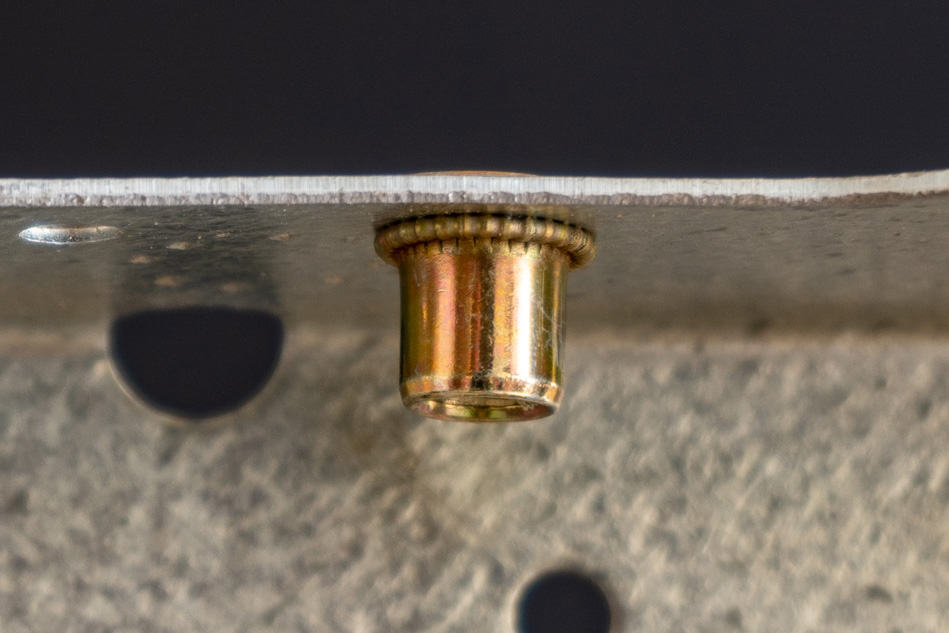
A Rivet nut works by creating a bulge on the nut that is on the backside of the material. Once the bulge has been created and tightened against the material, the Rivet nut is there to stay.

Rivet nut installed in metal

The following is an example of how these install.

Step 1: Drill or find a hole that is the exact diameter needed for the specific Rivet Nut you are using. The nut should fit in the hole snugly but not tightly. You should be able to insert it into the hole without any force.

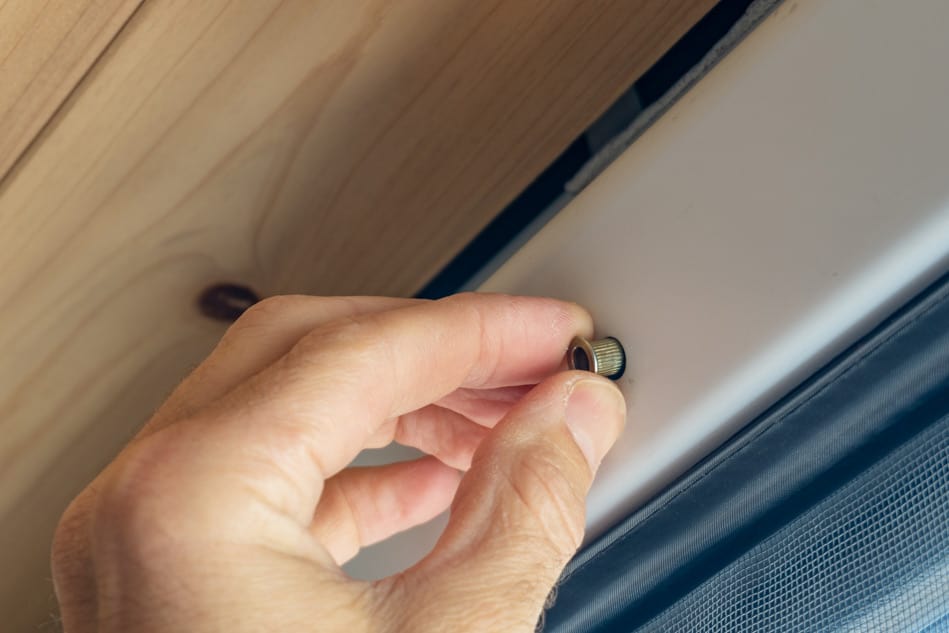
Inserting Rivet nut into hole

Step 2: Thread the Rivet Nut onto the threaded end of the tool using the proper sized attachment.

Rivet nut threaded onto tool

Step 3: At this point you’ll want to get your tool into the correct position and insert the Rivet Nut end into the hole. For the TackLife tool that I use, the handle should be in the open position as seen in the picture. This is typically the way it will work no matter what tool you are using.

Rivet nut tool opened

Step 4: Once inserted, hold the tool tightly against the material and then squeeze the handles down. This will put pressure on the Rivet nut and create the flange on the back that is necessary. Be sure to hold the tool straight as you squeeze the handles so that the Rivet nut will be perfectly seated.

Rivet nut tool closed

Once this is done, your Rivet nut should be tight and properly seated. You can check it by making sure you can’t move it with your fingers. You can also thread a bolt into it using a bit of torque and make sure it doesn’t move. If you find the Rivet nut still moving and not tight enough, you can re-insert the tool and squeeze a bit more. This may happen if you aren’t used to using the tool or don’t have it set up properly.

This happened to me at first a couple of times because I was scared to tighten down on it too hard. However, once I got the hang of it, I never had the problem again.

Each tool may be different so be sure and follow the instructions included with the one that you have.

Downsides of using rivet nuts

While Rivet nuts provide a great way to bolt something blindly to various types of materials, there are a couple of downsides to using them.

  • Cost. There is an initial cost to using these since you’ll need to purchase the Rivet Nuts themselves along with the tool to install them. Bolts are also extra so all of these combined will be considerably more than using something like a self-tapping screw or a bolt and nut if you have access.
  • Hard To Remove. Once you install these, you won’t be able to get them back out without doing some damage. If for some reason, one was installed incorrectly, you may need to remove and replace it. This can be done by drilling them out but it can be a pain in the butt to do.

Conclusion

Rivet nuts provide a great way to utilize an area where you only have access to one side. In the example of my van conversion, there were holes throughout the interior of my van. Rather than drilling anything new, I tried to use these holes as much as I could. These were used throughout the van and all of my ceiling and wall furring strips are attaching using this method.

They have held up well and after lots of trips over two years now, they haven’t come loose and everything bolted into them is just as tight as it was on day one. It’s a clean way to secure items in your van or anywhere else you may find a need for them.

8 Reasons Why Camping Is Good For the Soul

Camping is a great way to escape the technology-obsessed world we live in. There’s something about disconnecting from our phones, TVs, and computers to reconnect with nature that feels really good. You’ll get to unwind from the stress of your daily routine while surrounded by some of the best views and natural beauty this planet has to offer: forests, lakes, mountains — there’s no place like home!

I consider the occasional camping trip to be an absolute necessity. After staring at computer screens all day and being involved in such a fast-paced society, it is nice to disconnect for a little bit in order to spend time in nature. This is good for the soul and does wonders for your mental health. Sometimes we all just need to get away and live a simpler life. If you are struggling in your day-to-day, I would highly recommend a camping trip.

There’s a reason why so many people LOVE camping! Even though you may have to get your hands dirty and go without a bath for a few days, there’s nothing quite like the satisfaction you’ll get after the completion of a real camping trip. It refreshes your mind and is good for your soul.

Here Are 10 Reasons Why Camping Is Good For the Soul:

1. You Can Disconnect From Technology and Interact With Others

Sitting by a camp fire near a camper van

Camping is a great way to leave the busy world behind. Rather than scrolling through your social media feed or being on your phone all day, you get to interact with people around you and take in all the sights and sounds of the outdoor world. It is refreshing to be in touch with your surroundings and take the time to really experience nature and the community of others.

This allows you to breathe and slow down a bit rather than being consumed by technology. You can put your phone and other technological devices away and take a bit of a break from it all. When you are camping, depending on what part of the country you are in, there might not even be any cell phone signal. This is a great excuse to leave it all behind and let nature itself be your entertainment.

Of course, this only works if you make a concerted effort to avoid picking up your phone or connecting to the internet. This is time for you to take care of yourself rather than focusing on liking someone else’s status updates. It’s a time to take in the sights and sounds and to really connect with the beautiful nature around you.

This doesn’t mean that you can not use technology at all but if you expect to be refreshed on your camping trip, you should at least find a balance. Give yourself a few minutes a day with it and the rest of the time can be spent on soul-refreshing activities.

2. You Get To Experience a Beautiful Natural Environment

Camping often puts you in the middle of nature the way it was meant to be unless you find yourself in a crowded RV park. In this case, you may just have to pretend or opt for a location in the RV park that is more private and closer to nature (if available).

When off the beaten path, you can’t help but notice the complexity and magnificence of nature. It’s a meal for the soul that we all need to partake in.

It’s this type of trip that has you coming back home feeling more peaceful and in touch with what really matters.

Camping is often a soul awakening experience because you are in the woods or mountains where you can look up to the sky and see nothing but the stars. If you are fortunate enough to be in a location not affected by city light pollution, you will be amazed at the number of stars that fill the sky.

You have time for reflection and what better way to reflect than in this type of environment? It really puts life in perspective and gives you the opportunity to think about the things you value most in life.

I often hear lots of noises when at my home. From factories to trains to distant freeways, the noises are all around. Sometimes it makes me want to get away. Getting away allows me to have some quiet time, listening to a river flow, birds chirp, or other animals living happily. It’s a beautiful experience that re-energizes me and makes my soul feel a bit more complete.

3. Camping Allows You to Forget About Work for a While

Man at office desk with head in hands

By taking a few days off and spending time away from your normal work routine, you may just be able to find new inspiration that helps to heal your soul. A break from work can be exactly what you need in order to go back refreshed and recharged!

Who wants to work all the time? Many people do and experience burnout and health problems because they are always focused on work. After a while, you may start to wonder why anything even matters. If life is all about work and earning a paycheck then what’s the point?

I’ve been through this myself and is one of the reasons I converted my camper van. It’s a vehicle for me to get away when I need a much-needed recharge.

Camping allows you to get away and escape a mundane routine. You may even find that you don’t need more than a day or two in the wilderness to recharge your mind.

4. It Encourages Happiness and Playfulness

People take life too seriously! With all the work that has to be done, bills that need paying, worries that need to be considered, and so on, we tend to forget who we are and what is important. We get lost in the shuffle of life – until a trip away from it all sets us straight.

We only get one chance at this life and to waste it working and being so serious all the time is just ridiculous!

Camping is an escape from the structured way of life. It’s unstructured time that allows you to find yourself again and not just be consumed by the 9-5 routine that eats up your life. It allows you to be a kid again. It’s a time to play and enjoy your time away. Your worries can wait while you head off into the woods and search for a fun time. Your soul needs this!

5. It Allows You to Try Something New

If you have never been out in the wilderness on a camping trip, you need to try it. It makes you feel alive and adventurous. When life gets mundane, it’s good to change the schedule up a bit and do things that you wouldn’t ordinarily do. There is nothing like camping to change it up a bit.

This is especially true for those who have never even been camping before. Camping requires you to think differently, solve problems differently and solve them on the spot.

If you have experienced camping at a younger age but life has gotten in the way and you just haven’t gotten around to it again, you are in need of a trip. It’s good for the soul to do something new and different. It’s good to push yourself to do something that may be out of your comfort zone.

6. Camping Promotes Mindfulness

You’ve probably heard about all the benefits of mindfulness. Numerous books have outlined just how important it is to be present in the moment. Self-help gurus have educated us on the benefits of this great tool for true happiness. It helps us to live in the present rather than the past or future. We’ve heard how it can slow down the aging process, improve our health, and even how it can change our perspective on life.

This is because being mindful means you are living in that moment. You aren’t allowing yourself to be consumed by thoughts of regrets – or what if’s – you are accepting what is happening right then and there and embracing it for what it is.

Mindfulness can be hard to do if you are always in the same places and lifestyle. Getting away, seeing new sites, and breathing new air allows you to focus on the moment and what you are experiencing.

Mindfulness doesn’t have to be difficult and can be an amazing experience when you take the time to see what your senses are telling you. Just observing the nature around you and putting all your thoughts on that is an easy way to be mindful in the moment.

Since camping will help you to clear the technological noise from your life, you’ll have plenty of time for this practice.

7. You’ll Be In the Great Outdoors Breathing Fresh Air

There is a quote that I love that is written in chalk on my chalkboard in my van:

Escape and breathe the air of new places

Chalkboard in van with quote

This quote reminds me of how important it is to get away and breathe new air from new places. The sights and changes in the atmosphere can change your perspective on life. After a few days of smelling the fresh air of the outdoors, you may come back home with a renewed sense of purpose.

I recently spent four days parked by a flowing river in my camper van. I had all I needed but was far away from civilization. It was so nice to breathe the fresh air and hear the sounds of nature, and nothing more. There were no cars, factories, or other city sounds. It was an amazing experience that left me well-rested and renewed.

If you have the chance to get off the beaten path and get to a location where you can experience life without common noises and pollutants, you’ll see just what I mean.

8. Camping Gives You Time to Explore Hobbies or Spend Time Reading and Learning

Spending time camping leaves you with time on your hands to learn something new. Even if you don’t like reading, it’s a great way to spend your time off from work. You can get away, pick up a book or magazine and just get lost in it. If that isn’t enough, you can try to learn a new hobby or skill.

I recently started to learn to sketch. While camping by the river mentioned above, I was able to test my skills and try to sketch some of my surroundings. The result of the finished product was nothing to be proud of. However, the process of actually doing it was priceless. It allowed me to explore my interests while also being mindful in the moment.

It’s similar to the photography that I do which is also a mindful experience for me. I focus on a composition with my camera and am mindful of only that until I capture what I am looking for.

It may be something else for you that piques your interest but whatever it is, camping affords you a peaceful environment in which to pursue it.

Beyond hobbies, a good book is a great way to learn new things and help heal your soul. While not everyone loves reading, it is an activity that helps pass the time in a relaxing leisurely manner. You can bring books to read while you are on a camping trip and allow yourself to get lost in a story or to learn new things that may help to awaken your soul.

Conclusion

Many of us have soul-crushing jobs that make our lives miserable. A good camping trip can help you to slow down and appreciate the simple things in life once again. You can learn how to truly connect with nature again by taking a camping trip. It can be a great way to get away from your monotonous life for a brief period of time.

You may come back with a renewed sense of meaning and determination to change some things about your life. Your soul needs to be taken care of and camping is just one of the ways to help do this.

Thetford vs Dometic Portable Toilet – Which Is Best?

If you are on the fence about which portable toilet to purchase for camping or use in your van or RV, I know exactly how you feel. I have owned both of these brands of portable toilets and have had plenty of time to compare two popular models from each to see which is the best.

Portable toilets are similar to cassette toilets, only portable. While a cassette toilet is fixed inside an RV, portable toilets give you the same benefits while also allowing you to carry it anywhere you want. These are great for camping or off-grid living.

Thetford and Dometic are both well-known in the industry and offer products of different types. Their portable toilet offerings are similar in the way they work but do have some key features that may set one above the other depending on your specific needs.

If you are looking to purchase a portable toilet, chances are, these two brands have come up during your search.

The two models of toilets I have owned are the Thetford Porta Potti 365 and the Dometic 976. Each of these is similar in size as far as capacity is concerned with only slight differences. However, there are other dimensional differences that may be important to you as well as functional differences. Let’s take a glance at these two side by side and see how they stack up.

At-A-Glance

Thetford Porta Potti 365Dometic 976
Fresh Water Tank4-gallons2.3-gallons
Waste Water Tank5.5-gallons5-gallons
Dry Weight11 lbs12 lbs
Footprint Size16.3″H x 15″W x 16.8″D13.5″H x 15.5″W x 16.5″D
Seat Opening8″ x 10-1/2″7-1/2″ x 8-3/4″
QualityGoodGood
ComfortGoodGood
Warranty1 year1 year
Portable toilets in van with closed lids

Thetford

Thetford makes some really nice portable toilets. They are among the most popular for those who rely on these for their vans, RVs, and other camping situations. They are small, comfortable, and well-made which are key considerations when it comes to this type of solution. Let’s look at some of the pros that I like about the Thetford Porta Potti 365.

Pros

Well Designed & Built

Thetford has thought of it all for the most part. The toilet has a great design to it and it gives you a lot of features for its size. In my experience, everything works as intended and the dumping experience is about as clean as it can get with a toilet like this.

The swivel dumping arm combined with the push button vent makes for easy work when it’s time for this often messy chore. There are some toilets on the market that don’t have a swing-out arm and just splash out of the dumping hole that is flush to the container making them hard to direct into a dumping site or toilet.

It’s these types of details that set some of these more expensive toilets apart.

Features get even better if you choose the larger Porta Potti 565. You’ll have the option for an electric flush, fresh water gauge, and toilet paper holder. All of this combined with a full-sized toilet seat.

Large Capacity

Fresh water: 4 gallons
Waste water: 5.5 gallons

For such a small footprint, this toilet has a large capacity for both fresh and waste water. This means that you can go longer between dumping the tank. I prefer to dump mine as often as possible but the large capacity gives you peace of mind in case you aren’t able to dump it for a few days. You won’t have to worry about it filling up so fast.

Seat Opening Size

Thetford seat opening dimensions

Many toilets in this size range feature a smaller opening in the seat and are very uncomfortable for adults. However, the Porta Potti 365 has a wider opening than most.

The seat opening measures approximately 8″ x 10-1/2″

This is much better than some of the other ones I have tried, including the Dometic discussed below. This makes it fairly comfortable to sit on for an adult.

The downside of this is that the seat itself is more narrow to allow for this larger opening. You won’t have the same surface area that you may be used to from the full-sized toilet in your home. However, you’d be hard-pressed to find a larger opening on a portable toilet in this size range.

Made Using Strong, Flexible Plastic

I have found this toilet to be very strong and flexible throughout my usage. I have used it time and time again on many trips and have never had an issue with anything breaking other than a faulty flush handle which I’ll mention below.

The plastic itself is a flexible type of plastic that bends easily and doesn’t feel as though it’s going to break, even in cold temperatures. I have dropped the toilet, moved it from vehicle to vehicle, dumped it many times and it has always been a workhorse for me that has stood the test of time.

Cons

Lip Seal Goes Bad & Begins To Leak

Bad lip seal on Thetford toilet

As mentioned above, the lip seal on my toilet went bad in less than a year. I tried to do all the things the manual said to take care of the toilet and didn’t even use it that much. However, the lip seal started leaking and eventually shriveled up and became totally useless. In the end, I’m not sure if it was my fault or if I got a faulty unit. This is a replaceable part in case this ever happens to you.

Customer Service

Products have issues and you may need to contact customer support or go through a warranty process. As mentioned previously, the lip seal went bad in it in less than a year’s time with minimal usage. I also had the flushing mechanism break on me as I was flushing it one day.

I was disappointed in this so reached out to customer service for warranty replacement. Initially they said they would replace the toilet for me and asked for my receipt. After sending them my receipt and some back and forth emails which took a few weeks, they said a replacement would be sent. They told me it would ship out the following week via UPS.

However, no replacement was ever sent to me. I emailed them back about it but got no response. I ended up giving up and purchasing a new one since it was needed.

UPDATE: Thetford finally sent me a replacement toilet and rather than replacing my Porta Potti 365, they upgraded me to the Porta Potti 565e. It’s much appreciated but I do wish they had gotten back with me to let me know one was on the way. You can read my review of the Porta Potti 565e here.

Dometic

Much like the Thetford toilet from above, the Dometic 976 is a great option for those looking for a small toilet that has a good capacity. Many of the features are the same with slight differences.

Pros

Large Capacity

Fresh water: 2.3 gallons
Waste water: 5 gallons

While not as large as the Porta Potti 365, the Dometic toilet still offers nice sized holding tanks, especially for waste water. You will have to fill the fresh water tank more often but it will get most people through a few days of usage.

Carry Handles

Carry handle on Dometic portable toilet

The carry handles stick out on this unit making them obvious and easy to carry. They also provide a great way to loop a bungee cord through in order to store it away while driving. The Thetford is missing this feature and my bungee cord is usually just wrapped around the whole toilet itself.

These handles are sturdy and comfortable making the toilet easy to carry and dump.

Smaller Than The Thetford

This may be a pro but could also be a con if you are looking for a larger-sized toilet. I put it in the pros column because it is small and is easy to store away when not in use. If you only need one of these toilets occasionally, having one small in size is a great way to ensure it doesn’t take up much-needed room.

These are portable units so finding the smallest one that does the job is important. Of course, each person is different and will want something different. The size difference isn’t much but since the capacity on this one is smaller, the entire unit will take up a little less space.

Pressurized Push Button Flush

Dometic toilet push button flush

This toilet is marketed with less pumping in mind. The idea is that you pump the toilet up and then push a button when ready to flush. The button will allow you to flush multiple times before needing to pump it up with more pressure. It’s similar to a garden sprayer in which you pump it up and then the pressure allows you to discharge water into the bowl as needed.

I like this idea as long as it holds the pressure over time. I’m not sure about the longevity of this system. It could become a problem down the road as parts wear out or seals become less effective. This may render it useless if it stops holding pressure.

However, for now, it’s a great idea and convenient.

Cons

Small Seat Opening

Seat opening dimensions on Dometic portable toilet

The seat opening on this toilet measures in at approximately 7-1/2″ X 8-3/4″.

As you can see from the picture, it’s quite a bit smaller than the Porta Potti 365. This alone makes me shy away from it unless I need the smallest space-saving solution. For regular use, I like to have something a little larger that is more comfortable when using it.

This is perfect for children or small adults but can get quite uncomfortable for average to larger-sized adults.

Plastic Feels More Breakable

When using this toilet, I feel like it is going to crack under pressure. It’s a different feeling plastic than what the Thetford toilet is made of. It’s more of a rigid material that isn’t as flexible. It’s more fragile than the Porta Potti as I have seen from parts breaking under normal use.

Noisy Pumping

While the pressurized flushing feature is nice, the pumping required to pressurize it can be loud. This is especially noticeable in the middle of the night when you find it out of pressure and need to pump it while others are sleeping. Even pumping it slowly will produce a louder sound.

Customer Service

I had an issue with a broken toilet seat so contacted customer service for support. However, I never heard from them after multiple attempts.

Maybe I caught them during a bad time? I like to give them the benefit of the doubt. I have a Dometic refrigerator in my van as well and have had issues in the past and they were quick to respond and resolve the issue. Perhaps they just don’t take their portable toilets as seriously?

A Negative To Both of These Types of Toilets

Replacement parts

There isn’t much you can replace on these toilets other than the main seal and a few other small parts. Some portable toilets from other brands don’t even allow that. This means that once something goes wrong, you have to waste a large container of plastic. Tossing a big plastic box into the trash like this is hard to stomach if you are more environmentally conscious.

It would be nice if they made these with more replaceable parts so they wouldn’t create so much waste. It’s the nature of having the conveniences of products like this. In our throw-away society, when something goes wrong with a product we are using, it’s convenient to simply toss it in the trash and purchase a new one.

Conclusion

In my opinion, the Thetford Porta Potti 365 is the better toilet between the two.

I have used both and prefer the Thetford because of its larger seat opening and quality feel. Thetford also makes chemicals designed to work with their toilets so I like to stick with one brand in case something goes wrong.

Both of these have their place and if you prefer the smallest possible solution, the Dometic is probably the one for you. Neither are bad options but you’ll need to decide on the features that are important to you. Hopefully, the pros and cons outlined in this article along with my experience of using both will help you in your decision.

Van Life Projector and Screen – An Awesome Setup

I’m usually not one to care much for entertainment when exploring the outdoors throughout my travels. However, there are times when it can get lonely, especially when boondocking. You may find yourself far away from the ordinary crowd of people and other things that we humans are accustomed to. It can be nice having entertainment and something to make you feel more connected.

The small screen of a phone, tablet, or computer will help a little but having a proper entertainment system can really get you through when you just need that extra feeling of connection and entertainment. I’m not one that has to be watching movies all the time.

I mostly don’t like movies and have too short of an attention span to make it through most of them. Especially today’s movies that have gotten less and less interesting (in my opinion). Instead, I like to have something running in the background just to make me feel more connected to the world around me. This also includes local television so that I can watch the news, weather, and other updates.

A projector is a great way to accomplish this, especially in the small space that a van provides. Rather than having a TV mounted and taking up space, a mini projector takes up much less space and can be easily put away when not in use.

Whether a van or other small camper, the right projector setup will provide great entertainment for the whole family while taking up minimal space. Setting it up properly in your small space is key but once you have it in the optimal position, it can make the experience so much better.

Below, I’ll share what I have set up in my van and explain how I did it along with the parts I used.

Choosing a Projector For a Van

Nebula MAX projector in van

Choosing a projector for your van isn’t like choosing one for your home. You have probably noticed in your search that most portable projectors do not have native HD resolution. This seems odd in the age we live in to even see products like this that don’t have HD. If you were to purchase one for your home, you’d want to choose one with at least 1080p native resolution and perhaps 4k.

However, van life and camping situations present a different need. Portability and ease of use are at the forefront when considering camping situations.

After all my research, there was one projector that stood out above the crowd in key areas. The Nebula Capsule Max was the one I chose for my van.

This projector has a lot of benefits including:

  • Native HD at 720p
  • Bright enough for a van, RV, or tent at 200 ANSI lumens
  • Small & Lightweight
  • Easy to sit anywhere and point it where you need it
  • Vertical & horizontal keystone correction
  • Well-built, feels like it will withstand adventure
  • Has great sounding speakers
  • Doubles as a Bluetooth speaker
  • Built-in apps and wifi to allow you to connect directly to services
  • Offline viewing for HDMI devices or USB drives
  • Easy to mount on a tripod or ceiling mount with a standard 1/4″ tripod screw or sits easily on a countertop or other flat surface

I feel like this is the perfect projector for a van or for camping in general. With 200 ANSI lumens, it’s fairly bright. It has a lot of great features, great build quality, and multi-functionality.

Other Options

  • Nebula Capsule – This is a budget option from the one mentioned above. It doesn’t have native HD and also only has 100 ANSI lumens of brightness.
  • Apeman M4 – A great option that is small and mobile. It has native 480p and up to 100 ANSI lumens of brightness.
  • ViewSonic M1 Mini+ – A good small option if you like watching TV in the dark. It only has 50 ANSI lumens and a native resolution of 480p.

Things to consider

  • Brightness. Personally, I hate watching TV in the dark because it is hard on my eyes. Most portable projectors have minimal brightness so you’ll have to watch them in very low-lit environments. 200 ANSI lumens is as low as I would go unless you don’t mind having a very dark viewing environment. With 200 ANSI lumens, you can still watch it during the day or with some lights on in a van.
  • Keystone Correction. Having a projector in a van or RV might have you setting it up in awkward locations. Because of this, it’s important to have the ability to adjust the vertical and horizontal angles of the screen. It may not always be possible to mount the projector directly in front of the screen.
  • Noise. Some projectors are quite loud as their fans work to keep them cool. Be sure and choose one that doesn’t have an overpowering fan sound. The Nebula that I purchased has a light fan sound but is overpowered by the built-in speakers. You can hear the fan running when there is no sound coming from the speakers.

Projector Screen For a Van

After the projector, the screen is the next important part of the puzzle. Some people make their own or just aim the projector at an empty wall. I wanted a proper screen for my van that could be hung in different places and give me a flat-screen. You’ll probably need a small screen for a van rather than one of the huge ones that are typical of projector setups.

I chose a 40-inch projector screen that fits perfectly in all the locations that I would use inside my van.

40 Inch projector screen hanging in van

This screen is great because it hangs in various areas of my van via screw hooks in the ceiling. Once I am finished using it, it folds back down and can be taken off the hooks and put away. This makes it very portable but it still gives me a high-quality flat surface to watch the projector on.

This is a great screen but it’s not perfect. It does have some waviness to it and the sides curl a little but it’s more than sufficient for a mobile environment like a van or other RV.

Setting Up a Projector & Screen in a Van

The setup of a projector and screen in your van will depend on the layout you have. There is typically an obvious place to put it all. If you have a projector like mentioned above, it can sit nearly anywhere and point at a screen or blank wall.

Mounting The Projector Screen

If you purchase a screen as I have, it will come with a single anchor point on the top. Mine was off balance so hanging it with this single point made the screen crooked. If I wanted it to be straight, I would have needed to add some weight to one side. I considered doing this but decided on a different strategy.

Rather than using the one single hook it came with, I installed hooks on both sides. This would ensure a straight hanging screen and also a more sturdy one that didn’t sway and twist around. If your screen already has hooks on both sides then lucky you! If not, here is the solution I used for mine.

Mounting eyelets on projector screen

I used these stainless steel hooks that came in a package of 8. I used them throughout my van as anchor points for bungee cords and had a few left over for this project. D-Ring picture frame hangers may work just as well depending on the screen you have.

Just make sure you have clearance enough to do this. The screen I used had plenty of space to install these without being in the way of the screen functionality. I drilled a small hole and used small bolts and nuts to hold these hooks in tightly.

Bolts in projector screen

Once you have hooks on both sides of the screen, you can simply use some sort of hooks that install on the ceiling or wall to hang it.

I placed hooks in two different locations in my van so that the projector screen could be used in multiple ways. In the rear of my van, I used simple screw hooks that screwed directly into the wooden trim. This holds the screen so that we can watch the projector in bed.

Mounting projector screen in back of van

In the front of my van, I used 5/16″ Rivet Nuts and bolt hooks to create an additional place to hang the screen above the side door. I used this solution so that I could easily remove the bolt hooks when not needed. This gives me a place to watch TV while lounging in the dining area, or sitting in the swivel seats.

Mounting projector screen in side door of van

Placing The Projector

The Nebula Max projector that I used in my van has a handy 1/4 20 threaded hole in the bottom of it. Most projectors will have this so that they can easily be mounted to a tripod or a ceiling mount. The shape and style of the Nebula make for easy placement. You can just sit it on a countertop or the dining table or pretty much any flat surface.

The Nebula doesn’t have to be positioned directly in front of the screen. This is a benefit of having keystone correction. The vertical and horizontal keystone correction will straighten the screen up no matter where it’s located (within reason). The only problem with this is that horizontal keystone correction is manual so you’ll have to go into settings to fix it each time.

Because of this, I chose to mount my projector in two different locations directly in front of the screen locations.

I chose to mount my projector in various locations that would line up perfectly with the screen mount locations. I tried two different options for easy mounting but settled on one in the end.

Mounting The Projector

You can purchase a mount made specifically for projectors. However, these usually extend down too far for the small setting of a van or other RV. They are meant to be used in a home environment where you have much more headroom to work with. You’ll have to be a little more creative in your van to make this work.

Option 1 – Magnetic Mini Ball Head Mount

Installing magnetic projector mount on ceiling

This option requires you to mount a metal bracket to your ceiling unless you have access to bare metal in your van or RV. The idea is that you can have multiple mounting locations and then simply place the magnetic mount at your desired location when ready to use. For this to work, you’ll need a strong magnet mount.

I chose this ball head and magnet combo. It will hold up to 24 lbs (with 10mm thick metal) but I will be putting less than 2 lbs on mine.

However, I ended up only using the magnetic base out of this combo. The ball head was cheap and unusable. I ended up using a different ball head (Camvate mini ball head) that I ordered. I couldn’t find a magnetic mount by itself but between the two solutions I ordered, I ended up with the perfect solution for my needs.

For the metal bracket that mounts to the ceiling, I used a simple flat washer made of steel. I purchased a 1 5/8 inch washer with a small hole in the middle and screwed that to my ceiling via two small holes that I drilled on each side. You can find washers like this at any home improvement store.

Metal bracket in van for mounting projector

I also attached a safety strap to the flat washer by wrapping it around the screw on the ceiling side. This safety strap will clip to my projector, giving greater safety in the event that I accidentally hit it with my noggin. I built my own safety strap out of paracord using a custom version of the simple technique explained in this video. For the clip, I used something similar to these Op/Tech mini connectors.

The magnet mount attaches perfectly to the steel washer mounted to the ceiling and it and has a super strong bond.

Projector mounted with magnetic mount

Once, clipped in, there is no chance of my projector falling.

Projector dangling with safety strap

There are other solutions you can try as well. Metal plates can be purchased that are used for cell-phone holders. However, my washer solution was simple, small, cheap and it works great. I don’t see a need in using anything different.

As you can see in the picture, I can mount my projector in one location and if I want it somewhere else, just take it down and mount it in that location using the same magnetized option.

Projector mounted in different place in van

Option 2 – CCTV Camera Mini Ballhead Mount

If you don’t want to go the magnetic route, you might consider a small CCTV camera mount. I tried this as well but the problem with this, in my case, is that you have to leave the mount on the ceiling at all times. It does hang down a bit and hitting your head on it isn’t fun.

The mount I tried was the Camvate mini ball head. It’s a much better ball head than the one mentioned above.

The mount itself works the same as the magnet one above. It has a ball head on it with a lever to tighten or loosen it allowing you to move the projector into the perfect position. There are no magnets to mess with and your projector is tightly screwed in. This may seem more secure, especially if you have a heavier projector.

I ended up screwing this ball head directly to the magnetic mount and using this as my solution rather than screwing it into the ceiling.

Ball head mounted to magnet and without magnet

Either of these options work great but in the end, the magnetic mount made more sense for me. It makes it easy to hang the projector and put it away with only a flat washer remaining stuck to the ceiling. In my van, the washers blend in with the lights and aren’t really noticeable if you aren’t paying attention. They also don’t present a dangerous place to hit your head on.

If you have high ceilings, option #2 will work great and give you a very sturdy mount for your mini projector.

Summary

Using a mini projector in a small area like a van, tent, or around the campground is so cool. It provides a great entertainment system for those times when you need it. It comes in handy when the rain is coming down and you are trapped inside the van. You can put on a movie or downloaded show and have some background entertainment to keep you company.

There are many different ways that you can install one of these systems in your van but one thing I would recommend is to get the brightest lumen projector that you can. The brighter the better because you’ll be able to watch it even with some light pouring in. The cheap models on the market will usually require you to have a dark room to be able to even see the screen.

With the sound and HD quality of the Nebula Max, it makes the movie-watching experience such a pleasure. It’s much better than watching it on a tablet or laptop and can give you the option to take it outside as well. Project the screen onto the side of your van or RV while sitting by the campfire to make it a night you’ll never forget.

Class B RV Diesel vs Gas – Which Is Better?

It’s one of the many questions that people have when considering any type of RV. Since diesel or gas engines are available in almost any type of motorhome, it can be an area of debate. Making sure you get the right one for your needs is an important decision that shouldn’t be taken lightly. There are many factors that will determine which is best for you and the specific needs and wants you have.

A gas motorhome will be cheaper to purchase and maintain but won’t have the pulling power or longevity that a diesel engine will have. A diesel engine is a workhorse and is best for those who tow trailers or vehicles, drive mountain roads often, or haul heavier loads.

A diesel motorhome offers the power needed to drive almost any terrain. This can be important with larger RVs but is it necessary for smaller ones? Vans don’t usually haul items and don’t have nearly the payload of a larger RV.

However, there are still diesel options available for Class B RVs. You can easily find a gasoline engine Class B since this is standard but let’s look at the shortlist of options that you have when considering diesel.

Class B RVs With Diesel Engines

In the American market, you will only find plenty of manufacturers that off the Class B RV with a diesel engine. However, you can always expect them to be built utilizing only a couple of van chassis. These manufacturers will make use of the Ford Transit 3.2L Power Stroke or the Mercedes Sprinter 4 OR 6 cylinder diesel.

Although the RAM Promaster is a popular choice for Class B RVs, it does not currently have a diesel engine option.

You can purchase these as an empty cargo van if you intend to convert them yourself. You may also find manufactured models that have already been converted. The following list includes a few popular models that are possible options.

  • Coachmen Galleria
  • Airstream Tommy Bahama Interstate
  • Airstream Interstate 24GL, 24GT, 19
  • Winnebago Revel
  • Winnebago Era
  • Winnebago Boldt
  • American Coach – American Patriot
  • Leisure Travel Vans Free Spirit
  • Pleasure-Way Plateau FL
  • Roadtrek 2021 SS Agile

The Class B RVs on this list are very expensive models and are all built on the Mercedes chassis. This is what you will typically find when you are in the market for a van with a diesel engine. The cost of these rigs is almost always higher than what you’ll find with an RV that has a gasoline engine. Whether that price is worth it or not depends entirely upon your unique situation.

Why Are Diesel RVs Better Than Gas?

Diesel RVs aren’t necessarily better than gas RVs. However, they do offer some benefits over the gasoline option. A diesel engine can handle a heavy load better. You’ll be able to pull more weight, pass over mountain roads with no problems. It will last longer and maintain a higher resale value.

As mentioned above, there aren’t a lot of options for Diesel Class B RVs. The list gets even shorter when you consider affordable RVs. However, there are plenty of options available for Class A, C, and trucks that might be used to haul a trailer or truck camper. Let’s look in more detail at some of the reasons why a diesel RV is better than a gasoline RV.

They Generally Have More Power & Torque

A van with a diesel engine will likely be more capable of pulling heavy loads. This isn’t usually something that van-lifers are looking for but some may pull the occasional trailer and will need more pulling power to get the job done. It’s also good for larger vans that are fully decked out and are hovering around the top of the weight limit.

A fully loaded van that has substantial weight will be no problem for the power that a diesel engine provides. Consider this if you have a heavily loaded van or a larger family that will be traveling. This is one of the reasons you often see diesel engines in large trucks and buses. These vehicles have a lot of weight to carry and the diesel engine makes easier work of it than a gasoline engine ever could.

They Last Longer

A diesel engine is designed to withstand usage for a long period of time. They will generally have more longevity than what a gasoline engine can provide. They are great for highway driving and city driving alike. They can idle for hours and will perform better in stop-and-go environments than gasoline engines will.

When comparing a diesel engine to a gasoline one, you should expect the diesel to be the clear winner in the longevity department.

They Can Climb Hills Easier

The torque and power that a diesel offers will have you climbing hills without any problem. Rather than struggling to get over a mountain pass as you might in a fully-loaded gasoline van, the diesel one will do so with no problem. I have a gasoline RAM Promaster and haven’t had any issues at all with climbing up steep mountain roads but my van is fairly lightweight.

They May Be Better For The Environment

While both types emit bad things into the air, diesel engines have more complex emission systems than gasoline ones do. This is great news for those concerned with doing their part in producing less pollution. Their emission systems allow them to emit less CO2 which makes for a cleaner ride that you can feel better about.

While they are not perfect, they may be the better choice for those who are conscious of the environmental crisis we face. Of course, the best way to do your part in emitting less CO2 is to not drive at all. However, our world currently operates this way and relies on burning fossil fuels. All you can do is the best you can do and in the case of an RV, diesel may be the best choice in this department.

They Have Better Resale Value

Since a Diesel engine lasts longer, the resale value will be higher since parts don’t wear out as quickly. Besides that, there aren’t as many parts in a diesel engine so there is less that can go wrong. When you buy a vehicle with a diesel engine, you do so knowing that it is going to last for many years and many many miles.

Purchasing a diesel van with higher mileage isn’t as scary of a process as buying a gasoline van with high mileage.

Better Fuel Efficiency

While diesel fuel is more expensive, it burns more efficiently allowing the engine to have more power using less fuel. When you factor in the heavy load that a diesel may be pulling (or pushing), it is going to use less fuel in the process. If you have a heavy RV and travel large distances, this can be a way to fill up less and travel further on each tank.

If you only use your RV occasionally and do not travel long distances or over mountainous terrain, you probably won’t see much benefit. Petrol is cheaper at the pump and in today’s vans, the distance you can go on a gallon of petrol vs a gallon of diesel isn’t much less.

Why Choose a Gasoline RV Over a Diesel?

The diesel provides a lot of benefits as outlined above but a gasoline engine is what you’ll generally find in lower-cost and smaller RVs. It’s a faithful engine that also provides many benefits of ownership.

Ram Promaster V6 engine

They Are Easy To Find

Gasoline motorhomes are easy to find and are what you can expect to find the majority of the time you are searching. This is especially true of a Class B since they are small and don’t require as much power to propel them. A gas engine is a fine option for RVs with lighter loads.

They Are Less Expensive

The initial cost of the RV will be less if you choose one with a gasoline engine. Not only that, most people spend less money over the life of the vehicle. This is the way to go for most people who do not travel full-time or carry a heavy load. You’ll have to keep in mind though that if you plan to sell it later, a diesel will retain a higher resale value than that of a gasoline RV.

Lower Repair and Maintenance Costs

A gasoline engine has become the standard on the road, at least in the United States. For passenger cars and most work vans, you can expect a gasoline engine to be under the hood. Because of this, repair costs are low since parts are easy to get and nearly any mechanic can work on them. Beyond that, many repairs can easily be done by the owners. I have performed almost all maintenance on my Promaster myself.

A diesel engine isn’t as simple to repair and will usually need to be done by a qualified technician. They don’t have a lot of problems but when they do, you can expect to pay more than you would on a gas engine.

More Fueling Opportunities

Not every service station has diesel fuel available. You’ll have no problem finding gasoline but you may have to search further for diesel fuel depending on where you are at. According to a study by the U.S. Census Bureau, half of all service stations in the United States have diesel fuel available.

Easy To Service

A Class B RV with a gasoline engine can be serviced nearly anywhere. Ford and Dodge vans can be taken to most dealerships around the country as long as they can accommodate the height if it is a high roof. I have run into issues with dealerships that don’t have a door high enough to clear the high roof or don’t have a lift capable of holding the weight. In this case, there is often a commercial dealership they will refer you to.

In the case of a diesel, you will have a more difficult time finding a place to service it. It will also be more involved to do it yourself if you do not know the ins and outs of diesel engines. Gas engines are fairly easy to work on for qualified technicians and DIY-minded people.

Smooth & Quiet Ride

While the sound of a diesel engine can be like beautiful music to some ears, the quiet, smooth operation of a gasoline engine is the preferred choice of many. Even though today’s diesel Class B RVs have high-tech engines and are engineered better than ever, it’s hard to beat the smooth ride that you can expect from a van with a gas engine.

Driving in some of today’s models of vans feels like driving in pure luxury. While the Ram Promaster remains basic, the other options offered by Mercedes and Ford are designed with comfort in mind. You’ll feel like you are riding in a comfortable passenger car when you hit the road.

Bottom Line

Whether you choose a diesel RV or a gas RV, today’s models are solidly built and will provide you with many years of enjoyment. A Class B RV is small in size and usually does just fine with a gasoline engine. I have been more than happy with the 3.6L V6 in my Ram Promaster. It has plenty of power, gets great fuel mileage, and has been very dependable over the years.

All of today’s Class B RVs are capable of delivering a great experience no matter what they have under the hood.

If you choose a diesel option, you will pay much more since these are usually found in luxury models. In the end, both types serve a purpose and it will depend on your specific needs when determining which to choose.

How To Stay Healthy While Camping – 11 Simple Tips

Camping offers a great way to get away from the regular pace of life. I love the peace and serenity that can be found in nature and I have always been drawn to it. I have been exposed to this fun lifestyle my entire life and have been involved in it regularly since I was a child. I just can’t stay away from it which is why I travel often in my van and try to set up camp as often as I can.

Being someone who has always made health a priority, I strive to maintain a healthy routine no matter what I’m doing. However, when camping on short trips, it’s nice to take a load off and divert from the regular routines of life. This is fine on short trips but for those who camp regularly or live full-time in a van or RV, it becomes more important to consider healthier approaches in your routines.

If you are one of those who work hard to maintain a healthy lifestyle, you probably want to continue the trend even when you are on a camping trip. I spent a few years of my life as a certified fitness trainer so I know the feeling of always wanting to stay in shape and as healthy as possible.

The following tips are some that I try to abide by when I am on my trips. Although I make sure to get lots of relaxation and enjoy my time, I also am constantly mindful of living as healthy as possible.

1) Cook Your Own Meals

Vegetable Skewers

First, you have to plan and cook your own meals when you are out camping. This is usually not an issue for most people since cooking meals at the campsite is one of the best parts of the whole experience.

Cooking your own meals is a great way to control how healthy your food is or isn’t. When you opt to carry your own food and cook all of your own meals rather than buying pre-made meals or eating out, you can ensure that you are maintaining a delicious and nutritious diet. You have the choice to include healthier ingredients and make nutritious meals that also taste great.

It can be tempting to take a load off and just not fool with cooking. It’s easier to leave the campground, get some fast food and bring it back. However, cooking is one of the fun parts of camping.

Cooking a meal over the camp stove is not only delicious but creates a fun experience and lasting memories.

It can give you a break from typical restaurant food that people often eat while vacationing.

Cooking your own meals allows you to maintain a routine that you may be used to. The great thing about camping is it allows you to do this. Traveling and vacationing in other ways may not allow for such a thing since you will be left with only the option to dine out rather than cook for yourself.

While camping, you’ll have your kitchen with you and this affords you the perfect opportunity to cook some amazing meals.

Here is a great list of meals you can cook while camping.

2) Plan Active Outings

Camping is for the adventurous and those who love being in the outdoors. When you are in the outdoors like this, it’s a great time to plan outdoor adventures such as hiking, biking, mountain climbing, outdoor games, or anything else that you might enjoy doing that the outdoors can provide.

When camping, you are often in beautiful locations that offer a variety of activities like this to be done. Not only that, but you are not on a set schedule as much so you are free to pack your bags and hike or partake in activities as you wish.

Add some of this activity to your trip rather than just sitting around watching TV or scrolling on your phone. When camping in an RV at an RV park, it may be tempting to just spend all your time relaxing at the campsite. While you should definitely spend SOME time doing this, don’t forget to enjoy nature while you are there. This will certainly help you to have a healthier stay by allowing you to get your heart rate up, burn calories, and just make you feel good all around.

3) Use an Activity Tracker

Since you will likely be active during your camping stays, an activity tracker can help to motivate you, give you a goal to reach, and keep you moving. Set a goal for yourself to achieve a number of steps or another active measure during your trip. This will help to give you something to stretch for and keep the importance of moving in the back of your mind.

You will be surprised with just how many steps you will take when going on a simple hike. On average, a person takes more than 2,000 steps to complete a mile of walking. Imagine going on a few hikes that range from 1 – 3 miles while you are camping. These distances are what you can usually expect on nature trails that are designed for family enjoyment. You can usually find nature trails like this no matter where you are.

Backcountry wilderness trails will take you even further so if you want the extra activity, head for the backcountry. Either way, having an activity tracker can help give you the push you need to be active. The Apple Watch or the Fitbit make great choices and both provide you with useful feedback.

4) Prepare Healthy Snacks

Granola bars and nuts

After you have planned active outings and have begun to pursue them, you’ll need some snacks along the way. Snacks are great for providing you with a boost of nutrition throughout the day and giving you the energy to tackle physical challenges. If you go on a hike, make sure you take some snacks which could include fruits, nuts, jerkies, trail mix, pretzels, etc.

It’s easy to prepare small bags or containers of snacks that can be stuffed into a backpack anytime you are out and about.

5) Maintain a Routine

Even though you are camping and taking a load off, so to speak, it is important to maintain some type of routine. While it doesn’t have to be exactly like your routine would be when not camping, it does help to maintain some sort of routine. Some ideas may be…

  • Going to bed around the same time each night
  • Awaking around the same time each morning
  • Maintaining a regular meal schedule
  • Doing physical activities at the same time
  • Relaxing at the same time

All of these routines will help you to pack all that can be done into your day.

Maintaining a schedule of events and activities will help you to come back with stories rather than just a boring trip where you relaxed the whole time.

Not that there is anything wrong with this but staying healthy requires some thought and action so just be mindful of this on your trip.

6) Use Natural Ways To Keep The Bugs Away

Drinking a beer with bug netting in van door

Bugs can be quite annoying when camping and can make it downright miserable if you don’t have a plan to combat it. Whether it’s mosquitoes, flies, beetles, gnats, no-see-ums, ticks, or other pesky creatures, camping will expose you to a variety of these nuisances. The usual way to combat these is through a combination of bug screens and bug sprays.

I try to use bug netting as much as possible and this is enough if I’m staying in my camper van most of the time. The bug screen on my van keeps most things out so that I can enjoy my stay. However, once I venture outside the van, I have to contend with the same bugs that haunt any other camper.

Certain bugs can cause health problems and it’s especially a concern in areas where high numbers of ticks live. A natural bug spray or clothing designed to repel and kill ticks is a great way to ensure that you don’t fall victim to their bites. I typically use a natural bug spray to keep bugs away from me combined with clothing pre-treated with Permethrin for when I am venturing into territory where ticks might be living.

A bug spray like this one contains natural ingredients and does a pretty good job of keeping the bugs away. It does wear off and needs re-application often but it works pretty well from my experience.

7) Stretch Often

Just because you are taking some time to relax and chill doesn’t mean that you can’t get injured. You may actually have a bigger chance of being injured while camping if you are not careful. Carrying large water jugs, hooking and unhooking trailers, picking up heavy items, setting up camp will have you in positions to potentially injure yourself.

Spending some time stretching out your muscles will help give you more mobility to tackle any of the activities that present themselves. Stretching is often dismissed as a trivial exercise but it’s super important to keep muscles in a flexible condition for when situations arise.

It only takes a few minutes each day to stretch out various muscles doing some basic stretching exercises. Try some of these stretches the next time you find yourself at the campsite.

8) Carry & Drink Lots Of Pure Water

Make sure you have plenty of good quality water on your camping trip and don’t forget to drink it often! While camping provides time to relax, it’s no time to put off hydration. Being outdoors will suck the energy out of you, especially in the heat. In order to maintain a healthy functioning body, you need proper hydration at all times, not just during times of physical exhaustion.

Depending on the type of camping you are doing, you may want to consider a high-quality water filter. These can either be large-scale filters, bottle filters, or even something like the LifeStraw. These are great to have when you are in areas where access to clean drinking water is sparse. Even if it is only used for emergencies, having a water filter will ensure that you can drink water from various sources when you find yourself out in the wilderness.

9) Protect Yourself From The Sun

The sun can beam down heavy during the summer months and can become a problem for those who don’t take precautions. However, you may want to be cautious of the type of sunscreen you use. Many of them contain ingredients that might be toxic. I tend to err on the side of caution and always choose natural options that don’t contain these.

I recently used Raw Elements Natural Sunscreen and it was a good choice. However, it’s usually easy to find a good sunscreen that doesn’t contain lots of harsh chemicals.

This stuff gets slathered onto your body and absorbed by your skin. If you are going to be out in the sun, it’s best to use a combination of things to help combat the sun. A sun hat and sun-protective clothing will go a long way in helping to protect your skin when spending time outdoors. At the least, a standard ball cap will help to keep the sun out of your face and from getting burned.

I wear a large hat from Outdoor Research. It makes me look like a goober but it keeps me from getting burned on my face and neck.

It can be easy to forget about these things when you are on a trip having fun. It’s best to always include these types of products in your RV or with your tent supplies so that you never forget them when you head out on your trip.

10) Wash Hands Often – Carry Hand Sanitizer

Camping can be a dirty experience that is far from our modern-day customs of being squeaky clean 24/7. Instead, camping will have you stinky, sweaty, with dirt on your hands and under your nails. You probably won’t feel like a clean city dweller when out on your trip. It will make you appreciate the act of taking a shower more than you ever have.

It can often be difficult to even find a place to get clean depending on your style of camping. Even if you have a shower in your RV, you may be in a place where water isn’t available or you are in water-saving mode.

The easiest way to make sure you can keep bacteria off your hands is to always keep a plentiful supply of hand sanitizers with you. Those who camp will often touch lots of things that may present a problem if not washed off. It’s important to keep your hands as clean as possible especially since you will be preparing food and eating with those same dirty hands.

11) Enjoy The Journey

Woman at campground reading book in hammock

Perhaps the healthiest thing you can do when camping is to clear your mind and enjoy the journey. Don’t allow any stresses to take over and allow yourself to just let go of worries and troubles of your normal life. I know this is easier said than done. We all have troubles that haunt our thinking and camping gives us a great way to put them behind us, if even for just a short while.

Being active on your trip with some of the activities mentioned above can help you to stay physically fit and make some great memories. However, you will need to reflect and be mindful of the journey if you expect to get the most out of it.

There can be a lot of moving parts to a camping trip. It’s easy to get stressed out and ruin the trip for yourself and others. Don’t let this happen. Live in the moment, enjoy the journey, and consider the way you want to remember your trip.

Make memories that will last a lifetime and make it a trip that will make you smile when you think back on it.

Summary

Staying healthy on a camping trip is easy to do since you are in control of the entire trip. You have the opportunity to set your campsite up, cook healthy foods, choose physical activities, and clear your mind from the distractions of the world. Being healthy is something that happens when you give thought to your entire body including your physical and mental faculties.

Camping provides the perfect opportunity to enjoy a healthful vacation and give you much-needed rest and relaxation. Make the most of it and do something good for yourself on the journey.